Showing posts with label CCTV. Show all posts

Sunday, 24 October 2010

The Curious Case of the Jag That Parked in the Daytime

Two weeks into the 7/7 Inquests and we've heard about the strange lack of CCTV footage of any of the four accused from the day, the even stranger account of the police investigation which led to the car park in Luton before the accused had been identified at King's Cross Thameslink station, the lack of interest in pursuing and interviewing a 'fifth man' and now we have the strange case of a Jaguar at Luton that seems to appear there at the same time as the accused on both 28 June 2005 and 7 July 2005.

Before the Inquests started no CCTV footage had been released showing how three of the accused, Khan, Tanweer and Lindsay, made their journey to Luton Station on 28 June 2005, a journey touted as a dummy run or rehearsal for 7/7.

A Freedom of Information request submitted by J7 asking for precisely these details was refused by the Home Office.

The Official Home Office report into the events of 7/7 (the "narrative") states:
Other aspects of the planning

65. There appears to have been at least one recce visit to London on 28 June by Khan, Tanweer and Lindsay, but not Hussain. They made a similar journey from Luton to King’s Cross early in the morning and travelled on the underground. They are picked up on CCTV near Baker Street tube station later in the morning and returning to Luton at lunch time. Lindsay was later found to have a chart of times taken to travel between stations which he might have written during this recce. Tickets found at 18 Alexandra Grove also suggest visits to London in mid-March.

66. Other things suggest discipline and meticulous planning with good security awareness including careful use of mobile phones and use of hire cars for sensitive activities associated with the planning of the attacks. There are some indications that Khan was worried about being under surveillance during this time.

Source: Report of the Official Account of the Bombings in London on 7th July 2005
At some point in early 2011, the Inquests will hear the evidence regarding how the events of 7 July 2005 were investigated, so it might be worth bearing in mind events that occurred in Luton car park on these two days.

Perhaps the Inquests will also help explain why men so 'worried about being under surveillance' would hang on to their tickets from a journey to London in mid March, and also how these tickets came to be found in 18 Alexandra Grove, the alleged 'bomb factory', a location that apparently wasn't used until June 2005, some three months later.

In his Opening Statement to the Inquests, Mr Hugo Keith QC, felt the need to mention Conspiracy Theories that have arisen around the lack of released CCTV footage and the quality of the footage that had. He continued:
[MR KEITH] Turning to the CCTV which appears to be the object of the substantial bulk of the claims, there is nothing to suggest that, where there is CCTV missing, this reflects anything other than the fact that many CCTV systems do not continuously record.

Where there is CCTV missing, Mr Keith? Such as King's Cross underground station, the McDonalds visited by Hasib Hussain, the number 91 and 30 buses that Hussain is alleged to have boarded, as well as at significant moments in Luton station car park on the morning of 7 July 2005.

Whilst we have no evidence to suggest that there is anything sinister about the coincidental movements of a dark-coloured Jaguar at Luton station on the mornings of both 28 June 2005 - the 'rehearsal' - and 7 July 2005, there is plainly evidence of more than a lack of 'recording continuously'.

What is evident is the editing of the CCTV footage at significant moments, which begs the questions:


What precisely is being cut from this footage, and Why?


Jaguar at Luton station car park from J7 Truth Campaign on Vimeo.

Update: The graphic below shows:
  1. The last frame of CCTV footage before the cut,
  2. The first frame of CCTV footage after the cut,
  3. An animated panel that cycles through images 1 & 2.
Graphic showing the CCTV frames before and after the cut

Sunday, 17 October 2010

The Final Curtain - "CCTV rich" to "CCTV FAIL!"

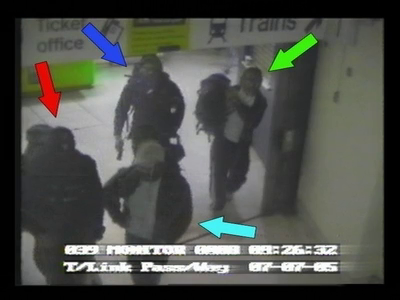
"In the next image, this is the last sighting of Lindsay, Khan and Tanweer. This was the first CCTV sighting that we had on the unit on this enquiry as they pass through towards the underground station."

DI Kindness, to the 7/7 Inquests 13 October 2010
Q. [Hugo Keith QC] Can you recall on what day you first spotted a number of men walking through the King's Cross area, in particular through the Thameslink station carrying rucksacks?
A. [Detective Inspector Ewan Kindness] It was on 11 July 2005, sir.
Q. So on the Monday?
A. It was, yes.
Q. Can you recall what it was about the appearance of those men on the CCTV that alerted you to the fact that you might have identified the bombers?
A. My officer, who was engaged in the actual CCTV recovery, was ex-military. He saw the four individuals walking through and they were walking two by two and he felt it was significant. They were carrying large rucksacks and he brought my attention to it. I concurred with him that it was a matter of priority for us.

On Day 4 of the Inquests it became clear that the image above was the last piece of CCTV, according to the Metropolitan Police, that exists of the four accused together anywhere near King's Cross underground station and also the last of Khan, Tanweer or Lindsay.

CCTV footage of Hasib Hussain outside King's Cross was shown to the Inquests and released to the press. However, no other footage exists, we are told, that shows the movements of Khan, Tanweer or Lindsay after the King's Cross Thameslink was captured. Why not? Especially when on 11 July 2005, Deputy Chief Constable of the British Transport Police, Andy Trotter, boldly announced, "The Underground network is a CCTV-rich environment".

The exchange below, between Mr Patterson QC, counsel for the bereaved, and Detective Inspector Ewan Kindness, provides further details. Details which only become apparent to keen listeners in attendance at the Inquests or eagle-eyed readers of the transcripts because, as usual, major show-stoppers in the official "narrative" of 7/7 are regularly and completely ignored by the press.
MR PATTERSON: Officer, we then watched the footage -- and I don't think we need to play this, thank you -- of the men entering the railway station. In fact, we don't actually see them buying tickets, do we, in the footage? Were you able to find any footage or CCTV evidence that helps to explain how they got their tickets?
A.[DI EWAN KINDNESS] I can't recall the tickets being purchased.
Q. Then in terms of the journey south, I think you told us that there were no cameras on board the train, is that right?
A. That's correct.
Q. When they got to King's Cross, in terms of the available footage, although there were quite a few cameras at King's Cross station, is it right that the only cameras that were recording for the relevant time was a camera in the tunnel?
A. There were 76 -- it was a temporary system. King's Cross underground had a temporary system in place. 76 cameras moving in sequence from one second at a time. Fortunately for us, at the appropriate period, between 8.30 and 8.50, it sat for 20 minutes on that one camera and that allowed us, at that period, they came through and we got the first sighting.
Q. Is there any footage of the mainline station as opposed to the Thameslink station?
A. When you say "mainline", do you mean mainline King's Cross?
Q. Yes.
A. At some distance away?
Q. Yes, is there any footage, CCTV footage -- you referred earlier today to many, many hours of footage that would be relevant to the emergency response.
A. I mean, King's Cross mainline footage was that which Hasib Hussain has been identified on, so that's some of it. Of course, it's quite a large estate, but there is definitely King's Cross mainline footage.
Q. So if anyone wants to look at footage of the platform or of the escalator, there is footage that has survived of all of those different areas of the mainline station?
A. I would -- I mean, we'd have to check the schedule, sir, but from my understanding, that would have been seized and certainly was viewed, so it would be accessible, yes.
Q. Was it possible to find CCTV footage showing the area of the station where the witness, Joseph Martoccia,
A. Could you just provide me a little bit of information about what he sighted, sir, just to refresh my memory?
Q. He was a witness who described seeing the group. He described four to six Asian males with rucksacks, and hugging and euphoric I think --
A. Certainly euphoric, but, no, there was nothing, we looked for that, sir, and there was nothing at all.
Q. That wasn't covered by cameras?
A. No.
Q. In terms of the platforms and the Circle Line heading west and the movements of Mohammed Sidique Khan, presumably you looked but that wasn't covered?
A. That's correct.
Q. And heading east and the movements of Shehzad Tanweer, presumably you looked --
A. Yes, we did.
Q. -- but there was no coverage of him boarding the train?
A. At King's Cross?
Q. At King's Cross.
A. No.

From this we learn that "a temporary system" of 76 cameras was installed at King's Cross, but that it malfunctioned for 20 minutes between the crucial period of approximately 8.30am - 8.50am on the 7 July 2005. This "malfunction" left just one of 76 cameras actually recording CCTV footage. Fortunately for the investigating officers, the one camera which remained in operation happened to be the one which was trained on the tunnel between the King's Cross Thameslink station and King's Cross mainline station. This one CCTV camera captured the image shown above.

The distance between the Thameslink tunnel where this image was captured and the King's Cross underground lines is shown on this map:


Note: The account of this image being the key that led the investigation back to Luton station has been thoroughly discredited under questioning by Ms Gallagher QC, counsel for the bereaved. This is examined in detail here.

This means that:
  • There is no CCTV footage from the underground showing Hasib Hussain allegedly on the Northern Line,
  • There is no CCTV footage showing the "iconic" but never seen image of the four men hugging euphorically,
  • There is no CCTV from the ticket gates, subways or platforms showing any of the four accused at King's Cross.
It isn't clear yet whether any CCTV exists from the trains as Patterson didn't question DI Kindness on this issue but, given the following account from Rachel "North", it would be surprising if footage from the trains didn't exist. At a meeting in May 2006 between survivors and bereaved and the then Home Secretary, John Reid, Rachel "North" noted:
Over to the questions. The first question was from a man who lost his boyfriend at Russell Square who wanted to know if there were CCTV images of the bombers on the trains, and whether he could see the last minutes of his loved one. The Counter Terrorism representative said that there were, but they had not been released, as the post-bomb CCTV images 'were disturbing'. Dr. Reid promised to investigate whether images of the train before the bomb could be shown privately to the bereaved man. It sounded like the CCTV images were not of good quality.

If DI Kindness' statement is correct, and the image shown above is the last sighting of Khan, Tanweer and Lindsay, any footage that might exist from the trains will not show any of the three accused.

So, what about any other crucial CCTV from the events of 7 July 2005 that might go some way to proving that the four accused were actually on the trains and the number 30 bus?

There are reams of footage showing Hasib Hussain in and around King's Cross and the Euston Road, but what about the footage from Hussain's infamous trip to MacDonalds, where it is claimed he inserted a 9 volt battery, purchased minutes before from W.H. Smith, into his 'malfunctioning explosives'?
Q. Finally this, Inspector: the movements of Hasib Hussain, you've shown us the various bits of footage of his movements and of the buses. Was there any footage from inside McDonalds restaurant where he seemed to be present for some 8 minutes?
A. There was no footage. We recovered the CCTV from McDonalds, but unfortunately the system was -- the recording was stopped prior to him going into that location.
Q. So there were cameras, but for some reason they weren't recording?
A. There were cameras and, in fact, you see the office manager in the office going to the video machine and switching the "stop" button and it stops.

How about footage from the Number 91 bus that Hasib is alleged to have boarded before allegedly switching to the Number 30 at Euston Station?
Q. Then finally the buses. The number 91 bus that he was believed to have taken along the Euston Road, no cameras inside that bus?
A. No, sir, no.
Q. Is that because there were cameras and they had malfunctioned or --
A. I can't recall the reasons why, but it was a main priority for us to find him on the bus, as you can see by our actions on the night of the 7th, to get the route 30 bus footage to identify him. So when we had the witness statement stating that -- the 91 bus, that was a priority for us to identify it and, for whatever reason, we didn't identify that footage. So I can't say at the moment whether that was malfunctioned or it wasn't there, it was recorded over, but for one of those reasons why we didn't have access to it.
Q. The same with the number 30 bus, there were cameras, but it wasn't --
A. The route 30 bus had malfunctioned earlier in the year, so we identified it that night, we viewed it that night at the laboratory, and it showed footage from earlier in the year, nothing of the date in question.
Source: Transcripts, 14 October 2010
Afternoon session, p61, lines 13 on
So, no footage of Hasib Hussain from the Euston Road boarding the Number 91 bus, nor is there any footage from Euston station of him boarding the Number 30.

For over five years J7 have been calling on the government to 'RELEASE THE EVIDENCE" but, as a result of the revelations during the first week of the Inquests, perhaps we need to change our demand to, "WHERE IS THE EVIDENCE?"

Saturday, 16 October 2010

A CCTV Fuss About Nothing?

All witnesses to the Inquest take an oath. The oath is to tell the truth, the whole truth and nothing but...

12 July In the early morning, the police search premises in the West Yorkshire area, including the homes of Khan, Tanweer and Hussain and 18 Alexandra Grove.

Report received that 4 people by two vehicles were seen putting on rucksacks at Luton Station car park. One of the vehicles was now missing but one remained in the car park.

By lunchtime, police working on the theory that there is a King’s Cross link to the 3 train bombs, all being broadly equidistant from there at the time of the explosions, identify a CCTV image of 4 men with rucksacks at King’s Cross. They recognise Tanweer first from a DVLA photograph.

The police identify CCTV images of the same 4 at Luton Station. The Micra is found at Luton and examined. 9 controlled explosions were carried out on material found in it. The Brava, which had been towed away because it did not have a parking ticket is later traced to Lindsay. There had been a report on the Police National Computer that the Brava may have been used in an aggravated burglary (see paragraph 69) and Lindsay was named as the registered keeper for the car.
During the morning session of Wednesday 13 October 2010, the Inquest heard from Detective Inspector Kindness of Scotland Yard's Counter-terrorism Command. After being sworn, DI Kindness was questioned by Counsel to the Inquests, Hugo Keith, and stated for the record that the identification of the four accused at King's Cross Thameslink, and thus the link made to the Luton and Bedford areas, occurred on 11 July 2005:
Q. Can you recall on what day you first spotted a number of men walking through the King's Cross area, in particular through the Thameslink station carrying rucksacks?
A. It was on 11 July 2005, sir.
Q. So on the Monday?
A. It was, yes.
Q. Can you recall what it was about the appearance of those men on the CCTV that alerted you to the fact that you might have identified the bombers?
A. My officer, who was engaged in the actual CCTV recovery, was ex-military. He saw the four individuals walking through and they were walking two by two and he felt it was significant. They were carrying large rucksacks and he brought my attention to it. I concurred with him that it was a matter of priority for us.

Under further questioning by Mr Keith, DI Kindness explains the manner in which Luton was discovered as the point at which the four accused met and travelled to London:
Q. Did you then concentrate your examination upon CCTV relating to the railway network to the north of London?
A. Indeed, sir, yes, and we were looking at the route of the -- the Thameslink route up through Bedford and Luton and looking for fast-time CCTV recovery of those stations to see where the bombers had access to rail network.
Q. Were you able to access CCTV relating to, not just the stations, but the car parks at those stations, the entry points and the foyers?
A. Yes, we were, sir.
Q. What did you discover?
A. We were able to identify that the individuals had arrived at Luton underground station earlier that morning and boarded a train to London.
Q. Can you recall when it was that you discovered that they had boarded the railway network at Luton?
A. I think it was on the 12th, sir.
Q. So the Tuesday?
A. Yes.
Q. As a result of that process, how many of the men were you able to identify initially as having used the Luton railway station?
A. We were able to identify all of the men had accessed -- the four men had accessed via Luton railway station.
Q. Were you able to identify the cars that they used at the station?
A. Yes, we were.
Q. So you were able to identify that they had arrived in two cars, a Nissan Micra and a red Fiat Brava?
A. That's correct, sir.

Note that DI Kindness is neither asked for, nor offers, any explanation for why Luton was chosen from at least eight possible stations that the 07.00 Bedford - Brighton Thameslink train would have stopped at on the morning of 7 July. Any investigation looking for potential al Qaeda "suicide bombers" would perhaps concentrate their efforts instead on Luton Parkway station, with its links to Luton Airport, and one stop closer to London than is Luton station. Eight stations would have furnished a lot of CCTV footage to examine within a maximum of 24 hours between the identification of the four men on the 11 July 2005 and the Luton link on the 12 July 2005.

One theory, indeed the one favoured by the Home Office narrative, is that Luton was chosen due to the witness sighting of four men putting on rucksacks at Luton station, as received on the 12 July 2005. This witness, Susan Clarke, gave her evidence to the Inquest during the afternoon session of 13 October 2010. She describes handing a note of the cars she had seen at Luton station on the morning of the 7 July to a British Transport Police officer at St. Pancras station. This note was handed over on Tuesday 12 July 2005. [Transcript, 13 October 2010, afternoon session - page 14, line 14 on]. Officers attended her place of work at 11.45am on 12 July 2005 and Ms Clarke was interviewed for two and a half hours at Holborn police station.

So this would appear to be how the Luton station CCTV came to be favoured and examined over and above seven other possible stations of focus. Or, at least it would be if either the narrative or DI Kindness were actually relating the facts of the matter. Fortunately for the bereaved and the wider public, the carefully plotted course of Mr Keith's questioning was exposed by further questions interjected by Mr Patterson and Ms Gallagher, the counsels for the bereaved. However, nobody would be aware of this through reading any of the press reports covering the inquest proceedings.

A CCTV viewing log was discovered in evidence that had shortly before been posted on the Lextranet system that the Inquests are utilising to share evidence between the counsel and interested persons. Mr Hill, representing the Metropolitan Police Service, attempted an objection to this line of questioning and Judge Hallett compounded the issue by reiterating the evidence so far:
LADY JUSTICE HALLETT: Strict rules of evidence, you're obviously right, Mr Hill. Do I take it, to try to cut this short, Mr Kindness, that essentially you were responding to somebody -- somebody else has got information and they've said, "All right, Detective Inspector Kindness, off you go, we want you to look at Luton and Bedford", is that really -- or did the information come to you personally?
A [DI Ewan Kindness]. The information -- Luton and Bedford was seized, my Lady, as a result of the sighting at -- as a result of the sighting at King's Cross Thameslink which had been generated by the CCTV viewing by the CCTV team. So it was natural that we would follow the route up the line. It's as simple as that.
LADY JUSTICE HALLETT: I think this is a fuss about nothing, Mr Hill, with respect.

Here's the kicker:
MS GALLAGHER: You say that you focused upon Luton station as a result of information received on 11 July. Is that right?
A. [DI Ewan Kindness] That's correct, yes.
Q. In that document which I've made reference to, I think you have it before you, my Lady, the Anti-terrorist Branch SO13 record -- do you have that document before you?
A. No, I don't, no.
Q. Is it possible for a copy to be provided?
MR KEITH: You can have my copy. (Handed)
MS GALLAGHER: This is a record of an officer viewing CCTV. It seems to be by a DC Stephen Bain. Was he part of the same team?
A. Yes, he was, yes.
Q. If you just look in the box at the top, it's on the left, five boxes down, "Date viewing commenced: 10 July 2005, 20.00 hours" and "Date viewing ended:11 July 2005, 23.30".
A. Yes.
Q. So is it possible that, in fact, that information was received on 10 July rather than 11 July, Inspector?
A. [DI Ewan Kindness] That's absolutely correct. It's an error. It should have been the 10th.

This leaves the one crucial and compelling question: Why were the police reviewing CCTV footage from Luton station and car park on 10 July 2005, when the accused apparently weren't identified on King's Cross Thameslink CCTV until a day later, 11 July 2005?

More importantly, why has it been deemed necessary to concoct the story about the discovery of CCTV at Luton on 12 July 2005?

The Inquests now need to scrutinise the actual manner in which the four accused were identified, and re-examine how, when and why the link to Luton station was made and how, when and why the CCTV was recovered, as the evidential log shows, by 10 July 2005.


On the fourth day of the inquests we learn that this one image of the four accused entering the tunnel from King's Cross Thameslink is the only CCTV image captured of the four men together anywhere near King's Cross underground station on 7 July 2005. More to follow...