Showing posts with label London bombings. Show all posts

Sunday, 7 July 2013

7/7 London Bombings: Eight Years On - Conspiracy Theories and Conspiracy Facts

July 7th 2013 marks the eighth anniversary of 7/7/2005, the day of the event referred to as the London bombings.  It also happens to coincide with Andy Murray's 7/7 win at Wimbledon, making him the first British man to win Wimbledon for - wait for it - 77 years.  The boy from Dunblane done good.  (The last British person to win Wimbledon was Virginia Wade in the Silver Jubilee year of '77, which was also Wimbledon's centenary year and marked by the queen in attendance at the final for the first time since her coronation.)

In the eight years that have passed since 7 July 2005, superficially, nothing much has changed. The 7/7 narrative stands as it has done since three months after the event occurred, accepted and unchallenged.  Beneath the surface, however, a great deal has changed, albeit not with the official conspiracy theory.  The official 'narrative' of events, aside from amendments the government was forced to make to it as a result of challenges to its authenticity made by J7: The July 7th Truth Campaign, remains unchanged and, unbelievably, unproven to any degree by any of the evidence released since.  

However, in the wider historical and political context of what are routinely dismissed as 'conspiracy theories' about State vaunted narratives, since 2005 a good number of other political challenges to dominant narratives have been revealed to be not as the imaginings of wild-eyed loons, but 'conspiracy facts'.   The tough question here with regard to these new conspiracy fact things is quite where to start with them and at what point to end to ensure that sufficient depth and breadth of coverage has been given to each, and to an exploration of the logical implications that necessarily follow a new understanding of historically significant events.

The Irish Conspiracy Theories

Before Islam featured in earnest in the list of mythical enemies against which we must all unite, its predecessors were the Irish who, the narrative of the time held, were responsible for unleashing untold violence on mainland Britain in service of clearly stated political objectives.  In some cases they did, but many cases tell a different story.  Since 2005 we have learned that the IRA and its political wing, Sinn Fein, were infiltrated to the extent that as many as one quarter of its membership were in some way cooperating, collaborating—nay, conspiring—with the British police, army and security services.  

If the IRA leadership becomes the focus then the level of infiltration by the British State rises to an incredible 50%. So, with regard to the 'Irish enemy' the chances are that they were nowhere near as menacing as made out to be and, in cases where they might have been, the State would have had - at the very least - oversight of any planned activities, through to involvement in those actions against subjects and UK residents.  This is not to say that the IRA didn't conduct attacks, just that politically motivated attacks tend to be aimed at political targets rather than innocent civilians, the latter has overtones of Operation Gladio's strategy of tension.

Consider also that many of the crimes attributed to the IRA, for which people were illegally and unjustly convicted and whose convictions were eventually overturned, and for which they suffered extended periods of imprisonment, have - like the 7/7 bombings - to this day not yet had one person justly and successfully prosecuted for their commission. 

The conspiracy theories about 'Irish terror' of old are the conspiracy facts of today.

The Iraq Conspiracy Theories

It was in 2005 that Conservative MP Andrew Tyrie became Founding Chairman of the All-Party Parliamentary Group on Extraordinary Rendition that examined the issue of extraordinary rendition and other related issues of State criminality.  Tyrie quoted the 'right honourable' Jack Straw MP as saying:
"Unless we all start to believe in conspiracy theories and that the officials are lying, that I am lying, that behind this there is some kind of secret state which is in league with some dark forces in the United States… there simply is no truth in the claims that the United Kingdom had been involved in rendition."

In late October 2012 Ian Cobain, in his book Cruel Brittainia, disclosed that Britain had been advised "within days" of 11th September 2001 of the American's plans to abduct 'suspects' and transport them to secret military prisons around the world.  Cobain also revealed that "MI5 and MI6 officers carried out around 100 interrogations at the US prison in Guantanamo Bay, Cuba.  Guantanamo's Camp Seven didn't officially exist for two years owing to a conspiracy to keep its existence secret, and it is there the CIA abuses and violates 'interrogates' its 14 choice alleged 'terrorists' and for which a $49 million request for a Camp Seven revamp has recently been submitted by the United States Southern Command.

In light of these revelations it's worth re-considering Jack Straw's words:
"Unless we all start to believe in conspiracy theories and that the officials are lying, that I am lying, that behind this there is some kind of secret state which is in league with some dark forces in the United States… there simply is no truth in the claims that the United Kingdom had been involved in rendition."

For the avoidance of doubt and in Straw's own words, everyone was right to believe in the rendition and torture "conspiracy theories"; right to believe "that the officials [were] lying"; right to believe that "[Jack Staw was] lying" and, further, right to believe "there is some kind of secret state which is league with some dark forces in the United States."  

Another so called conspiracy theory was, in a relatively short period of time, exposed as a conspiracy fact.  Better still, we have in the words of Jack Straw official confirmation of the existence of a "secret state" that operates hidden from public view, thereby making the age old "conspiracy theory" about the existence of an international Secret State, officially, a "conspiracy fact".

The Police Infiltrators Conspiracy Theories

Activists, usually of a left-wing persuasion, have long been the common enemy of capitalism and States that exist only to defend capital, property and private interests from those who necessarily have to go without to maintain the imbalance, have routinely been an issue, as far back as the Walsall Anarchists and beyond.  The State tries to persuade us that those that have human rights, workers' rights, animal rights - in fact any sorts of rights that the State, in service of capital, seeks to deny while simultaneously denying it is doing so - are malicious and malevolent people, bent on violence and menace to achieve their goals.  

The reality is very different most of the time, and on the occasions when it isn't, the years since 2005 have revealed many instances when it has been at the behest, not of committed political activists seeking to defend rights, but by State infiltrators who act as the protagonists and provide the means and method by which violent actions can be brought about.

Ongoing revelations about the depth and extent of the infiltration carried out by Bob Lambert, for example - who incidentally also happened to establish the Muslim Contact Unit (MCU) in 2002, whose existence seems to have not been reported until 20 July 2005 before receiving passing mention again in 2013 - offer a small insight into the nature of the State's conspiracy against activists, seekers of justice, the Irish, and now Muslims. Outstanding allegations again Lambert include an act of terrorism, perjury, assuming the identity of a dead child, and we should include his abuse of the women he misled into believing he was something and someone other than he was.

As yet, we have no idea what the real function of Lambert's Muslim Contact Unit, set-up three years before 7/7, might have been.  The parallels between the approach to activists and the way similar methods are applied to alleged 'terrorists' should inform everyone about how the State views challenges to its presumed authority.

Another conspiracy theory confirmed as conspiracy fact, and it's beginning to look like conspiracy is the default mode of operation in many ruling class circles.

And so it goes on

Many political challenges to State positions are often dismissed out of hand at the time as 'conspiracy theories'.  Recently, many of these conspiracy theories have, not for the first or last time, turned out to be 'conspiracy facts'.  And yet these 'conspiracy facts' are not related to relatively insignificant matters.  They relate directly to the dominant narratives championed by the State and the new Ministries of Propaganda formed by State and mainstream media broadcasters.

Conspiracy facts have overturned many received historical narratives intended to nudge the attitudes and opinions of the people in to a political worldview that ensures the status quo goes unchallenged.  As these illusory narratives melt away in tandem with any illusions that may have existed about the nature of the State and it's role in societies, so too melt away the last vestiges of the credibility of the State, its actors and its corporate co-conspirators.

While there may not be much by way of news and information about anything directly connected to the actual crimes that occurred on 7th July 2005, the story is far from over.  Freedom of information requests from concerned subjects insistent on chipping away at the tablet of State lies will continue; undoubtedly many will be refused as has happened in the past, we can but try. 

Eight years on from 7/7, J7's demand for a fully independent public inquiry, held outside of the terms of the Inquiries Act 2005, still stands, with added fervour now that the official Inquests process did not include the deaths of those accused of perpetrating the attacks in its scope.

J7's demand for the State to RELEASE THE EVIDENCE abides.

Tuesday, 12 July 2011

Murdoch phone hacking and 7/7 Investigation

From: "J7: The July 7th Truth Campaign"
To: homeaffcom@parliament.uk
Date: Tue, 12 Jul 2011

To the members of the Home Affairs Select Committee

The revelations of phone hacking by News International calls into question the role of the police and the Murdoch press during the investigation into the London Bombings on July 7th 2005.

A Times report written by Daniel McGrory and dated 25/08/2005:
The youngest of the July 7 bombers, he made three desperate telephone calls begging for help from the other members of the terror cell minutes before he blew himself up on a London bus.

The frantic last messages are seen by Scotland Yard as vivid proof that the British-born Muslim extremists intended to die in the attacks.

Knowing that all four men were supposed to synchronise the timing of the explosions, Hussain ran out of King’s Cross Underground station and tried to reach his accomplices by mobile telephone.

It was just before 9am, but by then all his fellow bombers were already dead. The other three had triggered their devices within seconds of one another at 8.50am.

Hussain is believed to have first called Mohammad Sidique Khan, 30, the alleged leader of the group, saying: “I can’t get on a train. What should I do ?” Then in quick succession he left the same message for Shehzad Tanweer and Jermaine Lindsay as, clearly agitated about his next move, he hurried away from the station.

A police source who has heard the telephone calls said: “His voice was getting more and more frantic with each call.” Investigators could tell from his breathless voice that Hussain was walking fast as he made these calls.

These messages were not played nor even were they claimed to exist during the recent 7/7 Inquests.

We need to know:

Did the Times hack the phone messages of the 4 accused of 7/7?

Who was the ‘police source’ who gave this information to the Times?

Why did the 7/7 Inquests not have an opportunity to hear these messages?

Why did the 7/7 Inquests not refer to these messages?

Regards

J7: the July 7th Truth Campaign

Thursday, 7 July 2011

6th Anniversary of 7/7

On the 6th anniversary of 7/7, J7 are once again forced to reiterate our demand for a fully Independent Public Inquiry held outside of the constraints of the Inquiries Act 2005.

At the conclusion of the 7/7 Inquests, Lady Justice Hallett named the 4 accused, Khan, Tanweer, Hussain and Lindsay as the perpetrators of the events of 7/7, despite the clear legal constraints that apply to Coroners and their ability to apportion guilt. Hallett concluded the inquest proceedings by refusing to resume the Inquests into the deaths of the 4. As part of our efforts to get to the truth of 7/7, J7 submitted a clear, detailed and reasoned submission to the inquests outlining why the resumption of these Inquests was imperative. J7's submission for resumption can be read here

As we stated in our submission:
  • The lack of representation of the families of the 4 men allowed any and all of the evidence presented to go unchallenged, meaning no witnesses called to the inquests were cross examined on behalf of the families of the accused.
  • The Inquests sat without a jury.
  • The Metropolitan Police investigation, Operation Theseus, was deemed to be outside the scope of the Inquests and thus the entire investigation behind Ian Blair's "largest criminal inquiry in English history" remains unexamined and unquestioned.
  • The Inquests for the 4 accused, in which a verdict of suicide would require a criminal standard of proof, were not resumed.
There are many glaring holes in the evidence that was presented to the Inquests, as detailed on the J7: 7/7 Inquests Blog which we set-up specially to report on the inquests, yet these potential showstoppers for the official narrative of events went unreported in the mainstream media. The absolute pressing necessity for a fully independent Public Inquiry is now greater than ever in order to enable anyone to have any confidence in the evidence by which the guilt or innocence of the four accused might be established. To date there has been no proper legal scrutiny of this evidence. Furthermore, in cases of alleged suicide, the intent to commit suicide must be proven and this burden of proof has not yet been met.

Without a full Public Inquiry, it remains the case that:
  • The bodies of Tanweer and Khan were not included in the 'Life Extinct' body counts carried out on 7th July by Dr Morgan Costello.
  • The police viewing of the Luton Station CCTV footage was conducted as early as 10th July, despite the official account clearly stating that the men were identified on CCTV at King's Cross Thameslink on 11th July, and that it was this discovery that led the investigation to Luton as a possible site of interest.
  • There exist no sightings of three of the men, Khan Tanweer and Lindsay, after the footage from King's Cross Thameslink, some way from the Underground tube network. Apparently the temporary CCTV system that was installed at King's Cross underground malfunctioned for the 20 crucial minutes between 8.30 and 8.50. Additionally, there are no recordings of the three from any other cameras. This means that there is absolutely no CCTV evidence that shows three of the accused anywhere on the London Underground network on the morning of 7 July 2005.
  • No CCTV from the pre-explosion tube carriages has been released, despite this CCTV apparently existing, and despite it being crucial evidence which could confirm or deny that three of the men boarded the carrriages they are alleged to have boarded. This CCTV should also have been made available to Colonel Mahoney when the expensive modelling of likely injuries sustained by the deceased was conducted to make up for the lack of any internal post mortems on the victims.
  • No CCTV exists from McDonald's showing whether Hussain actually used the premises to insert a new 9v battery into his apparently malfunctioning bomb, as it was revealed during the inquests that the store manager can be seen on CCTV (oh the irony) turning off the CCTV system before Hussain entered.
  • No CCTV exists of Hasib Hussain on either of the buses he is alleged to have boarded. There is no footage of Hussain aboard the number 91 bus, nor the number 30 bus he is alleged to have destroyed, nor is there any street or traffic camera footage showing him boarding either bus.
  • There is a huge discrepancy between the explosives allegedly used, as given in sworn evidence to the Jean Charles de Menezes Inquest, and the evidence that Clifford Todd gave to the 7/7 Inquests.
  • There is strong evidence in the public domain to suggest that at the heart of the story behind 7/7 lay at least three operatives for both the British and American Intelligence services, one of which served an insanely short period in a US prison, for greater crimes than those his testimony put behind bars for far longer terms, before being quietly released.
These questions and many more can be found on the 7/7 Inquests blog.

Six years on from an event with the largest single loss of life in London since the blitz can the Metropolitan Police, with it's long track record of complicity in facilitating Miscarriages of Justice -- and given the recent revelations that it is implicated in the Murdoch News of the World phone hacking scandal -- be allowed to offer a 'narrative' which is so deeply flawed and suspect? How about a 'narrative' which has remained unexamined and unchallenged except by J7? A 'narrative' that has ascribed guilt to four men without their families having the opportunity and legal representation to question, particularly when the four accused have been denied their own Inquest proceedings? Or a 'narrative' deemed outside the scope of inquiry by the 7/7 Inquests, and a 'narrative' which has led to the demonisation of the Muslim population? This is the same flawed and unproven narrative that has been the basis for the questioning of multi-culturalism and a 'narrative' which has done much to fuel the race-hate and bigotry of the far-right neo-fascist organisation, the EDL.

Current Prime Minister, David Cameron, has announced not one but two inquiries into the ongoing criminal exploits and activities of the press and police, just as news was breaking that the families of 7/7 victims were also victims of phone hacking at the hands of Murdoch media. This means that, as if we woke to find outselves in the midst of a Kafka novel, it is apparently right and proper to investigate whether or not the families of 7/7 victims had their mobile phones hacked, but it is not right and proper to have a full, in-depth, independent public investigation into how those same families of the 7/7 victims lost their loved ones.

J7: The July 7th Truth Campaign continue to say NO! This will not stand! Only a fully Independent Public Inquiry held outside of the constraints of the Inquiries Act 2005 has the vaguest chance of getting to the truth behind the 'narrative' of 7/7.

J7 will be writing again in the near future to ask for your continued support in our joint campaign for the truth about 7/7, and we will provide a few suggestions for ways you can help us pressure the government into commissioning an independent public inquiry.

For truth and justice,
J7: The July 7th Truth Campaign

Wednesday, 15 June 2011

A Nissan Micra Tardis?

The official narrative would have us believe that three of the 7/7 accused, Khan, Tanweer and Hussain, left Leeds in the early hours of the morning of 7th July 2005 after visiting 18 Alexandra Grove (the apparent 'bomb factory') and loading a rented Nissan Micra with home-made explosives of the type shown here:

The quantity of 'bulk explosives' claimed to have been found at 18 Alexandra Grove

According to the testimony of senior forensic investigator, Clifford Todd, only one of these substances was shown to be potentially viable as an explosive.
Q. Were there different types of sludge at the address?
A. Yes, there were two types. One was much darker than the other. One was a fairly light, sandy, yellow-brown colour. The other type was a much darker brown colour.
Q. Was there a difference between them, their effects?
A. Yes. The darker brown material, after various tests done at the laboratory, was found not to be energetic, so would not work as an explosive. The lighter, sandy-coloured material, that was shown, in at least one specific case, to be a high explosive.
That none of these containers could be forensically linked by either DNA or fingerprints to any of the four accused is an area which received no scrutiny or examination when DC Reynolds, of SO15 Counter-terrorism Command forensic management team, gave his testimony. Hussain's fingerprints were apparently found on only one plastic container which it was claimed contained HMTD. [1/02/2011 p13 13-15]

So, after collecting approx 40Kg of a light brown sludge that in "at least one specific case" could potentially possess explosive properties, the three men drove off in the rented Nissan Micra. Of note is that any less than "at least one specific case" would in fact mean that the sludge was potentially explosive in exactly "no specific case".

Despite much discussion of counter-surveillance methods by the use of 'operational phones' solely for use between the four accused, Shehzad Tanweer appears to have been quite content to give his 'operational phone' number on the rental agreement for the hired Micra. We know this because it is claimed that the car hire company called this phone on 7th July at 14.58, although, perhaps a little strangely, this was before the end of the rental period and we can only wonder what might have prompted this contact. This point was also contradicted by the statements from the car hire company read to the Inquests on 14/10/2010. [See pages 44 & 47]


A Nissan Micra is a very small car with a very limited boot capacity - yet it contained three men, two cool boxes, 40Kg of bulk explosives, five large rucksacks and a variety of other items, as shown in the picture below:


The items that were forensically linked to Khan, we are told, did not include the rucksack left behind in the Micra, nor the cool boxes which presumably contained the explosive substance, but  were  instead innocuous everyday items to which everyone can be forensically linked at a moment's notice: carrier bags, biros, sweet wrappers, etc.

According to the read statement of Sarah Lancaster, a Senior Case Officer in the Forensic Explosives Laboratory, also contained within the Micra must have been freezer ice blocks:
Based on my observations at the scene, my subsequent examination of the items submitted to this laboratory and in conjunction with the police photographs provided, it is my opinion that the damage in and around carriage 6713 of the Circle Line Underground train was consistent with a detonation of several kilograms, probably in the order of 10 kilograms, of a high explosive substance. [2/02/11 p46:6]

... exhibits which were reassembled to demonstrate that they were part of the freezer ice blocks and packs wrapped around the bomb. She concluded: "The use of freezer ice blocks and packs primarily suggests that it was necessary to keep a component of the IED cool. [ibid p50:15]


No explanation is given for the contents of the black bags in the right hand cool box - what did they contain?

After arriving at Luton station car park, and parking next to Lindsay's Fiat Brava, we presume that the men stood at the boot of the Micra and assembled their explosive devices - if they were already packed, primed and ready to go inside the rucksacks there would have been little need for the ice packs inside the cool boxes. It is also hard to see where five rucksacks already packed with explosives would have fitted into the Micra along with the three men as the boot was already full with the cool boxes.

Would any serious 'terrorists' with murder on their minds choose to park at a busy commuter station next to a pay and display machine and adjacent to an exit from the car park - in the position that the two blue cars can be seen in the image below - during the early morning rush hour if they were intending to construct these devices, packing them with ice packs and inserting initiating devices of wires, light bulbs and batteries? Standing at a boot of a car at a busy commuter station on the outskirts of London during one of its busiest times, in broad daylight, all watched over by CCTV machines of convenient fail?

Luton Station car park showing the area where the Brava and Micra parked

Is it even vaguely credible that the scenario described above is actually what really happened on the morning of the 7th July 2005?

Really?

Thursday, 7 April 2011

The Lynton House Mystery

by David Minahan*

Reva Cope and Regina Friel both featured in an article in the Sunday Times Magazine on the 4th December 2005 titled 'The Survivors'. They each recalled how after managing to get off the Number 30 bus after the explosion they went to Lynton House where they were looked after by office staff.

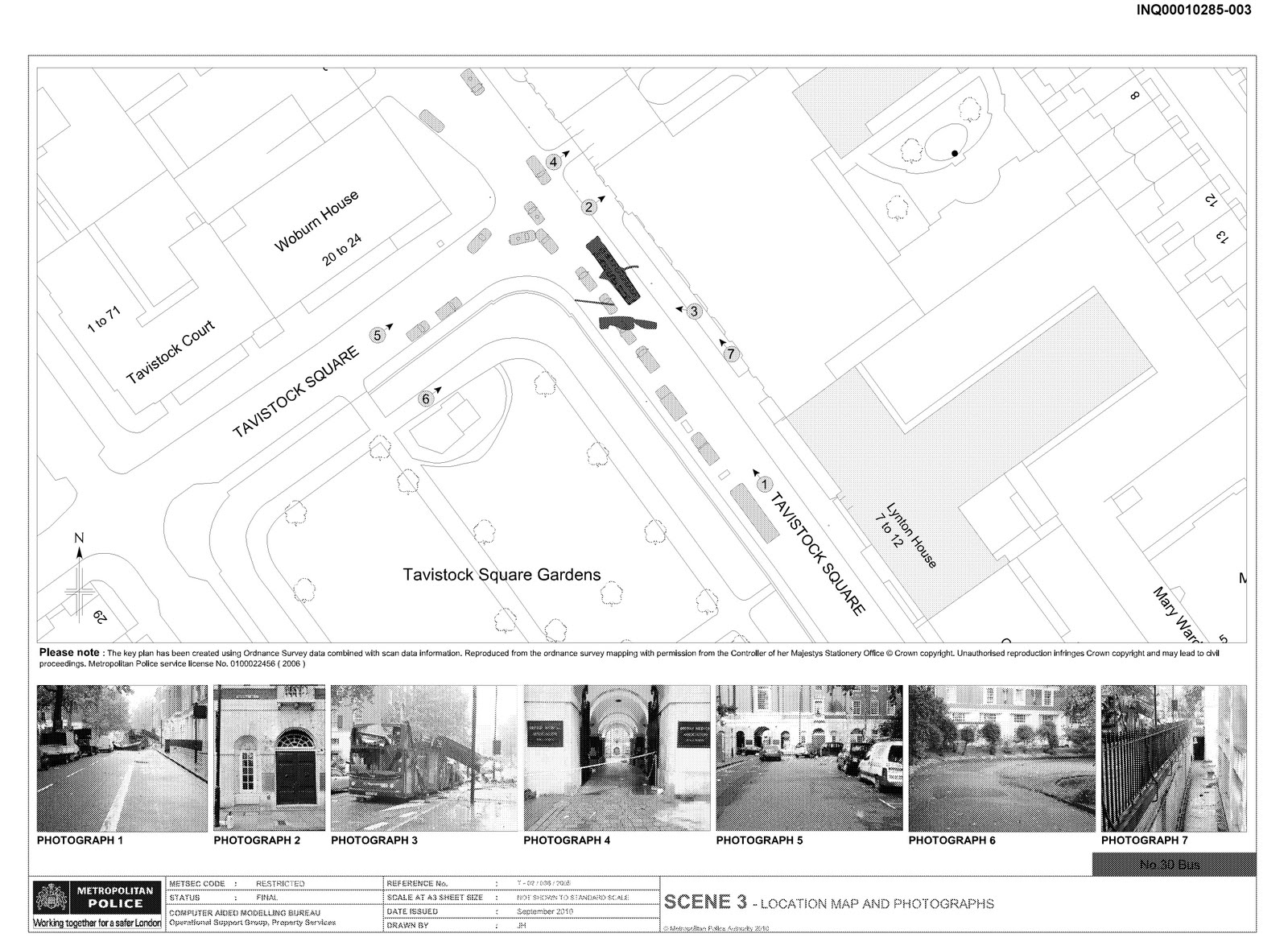
Regina Cope is number 14 and Regina Friel number 10 in this diagram

Curiously neither of these passengers were called to give evidence, nor were witness statements from them read out! Nor were any witnesses from Lynton House who aided the survivors called or had statements read and Lynton House is hardly mentioned during the 7/7 Inquests!

One of the passengers who did give evidence Gary O'Monaghan recalled how after getting off the bus “I landed on my feet and just started to run” [14 Jan p36:13] and “This is perhaps why I ran away fearing it would explode again” [p36:21]. He is, however, almost certainly the 'Gary' who appeared at The London Assembly 7th July Review Committee in 2006 and stated (page 202) that he had gone into the 'E.C.Harris Building' (which is Lynton House) and then declared (page 208) “I was staggered when I left. The whole foyer of the building was full with people on trolleys like that, all bandaged up”.

Interestingly another witness at the GLA Inquiry 'Beverli' who wasn't on the bus but worked in Lynton House for a consultancy firm that was involved with Olympic delivery recounted how she and her colleagues “were told as staff, that we were banned from talking to anyone - particularly the press, which was an immediate dismissal offence - police, or anything regarding the experience”(page 35).

An official reference to Linen(sic) House does appear in the document INQ10129-2 which was called up by Mr Andrew O'Connor QC on the morning of 19th January [p12:16]. This is a copy of a police log which, timed at 10:10:55, states “have 10 inj'd persons at Linen Hse 7-12 Tavistock Sq, WC1”. Possibly by coincidence, possibly not, Mr O'Connor a short while later [p36:21] whilst questioning WPC Kerslake, states incorrectly “The BMA building is where you see the words Lynton House, that's the name of the BMA Building”!!

A not dissimilar exchange can be found in the transcript for the afternoon of the 19th January, Michelle Du-Feu: ”At the time he (the security guard) was actually in the building immediately before that. I think its called Lynton House or something” [p6:22]. Mr.Andrew O'Connor: “I see. In any events the BMA building's on that side of the pavement. We know where the bus was just opposite” [p6:24].

[Editor: Lynton House was presented with a plaque from the Metropolitan Police almost immediately after, this report is date 19/07/05: "The lobby of Morley’s building, Lynton House, became a makeshift hospital for the wounded immediately after the attack. Some of the firm’s own first aiders were among the first on the scene after the bus was devastated by the bomb. At least another 20 businesses occupy space in Lynton House, and the Metropolitan police has presented a plaque for the building’s lobby area commemorating the help given by staff working in the building." source]

We can only speculate at the reason for all the official coyness. Could it be the numbers involved?

'Jaki Turner' wrote on the BBC London blog 'BBC London Bombings - 7 July: One year on': “Last year at this time I was working at Tavistock Square when the bus went up next door and we the first aiders at Lynton House dealt with some 35 people hurt on the bus”.

If we add those 35 to the casualties dealt with in the BMA Building and the County Hotel as well as the BTP Headquarters, Great Ormond Street Hospital, The Tavistock Hotel, Tavistock Court and the offices of the Rev Deborah Hodge, the three who PC Walker put into civilian vehicles and the five who Walter Hayden set off to UCL Hospital with and then factor in the “at least 13 patients” that Ambulance Officer Williamson had at Tavistock Square south and “the number of people with minor cuts and injuries” Dr David Tovey reported as being outside the back of the BMA building there will be a total considerably in excess of the 47 non-fatalities on the bus!

Which in turn raises other interesting questions!!

*David Minahan was by occupation a claims investigator for an insurance company and later a leading firm of solicitors and has experience of "forensic" matters. David was also the National President of a major Trade Union (MSF now merged with the AEEU to form Amicus). David researched and wrote the London Bombings Dossier published on the J7 website and says he is convinced that there has been a massive cover up and campaign of disinformation about the events of 7/7.

Tuesday, 5 April 2011

You Couldn't Make It Up!

by David Minahan*


Twenty five of the passengers who survived the explosion in the first carriage of the Piccadilly line train have given evidence, either in person or writing, to the 7/7 Inquest. This reveals that 12 of them actually entered the train at King's Cross, five of whom, Tracey Brade, Gillian Hicks, Garri Hollness, Paul Mitchell and Philip Patsalos recall getting on through double door 5 i.e. near where the explosion subsequently took place. Paul Glennerster was uncertain if in his case it was door 3 or door 5.

None of these witnesses had any recollection of seeing Germaine Lindsay!

Olawale Akarele, who entered through door 5 but further up the line at Turnpike Lane, indicated in his evidence on the morning of 1st December that he may have seen him. However his testimony was far from convincing and he admitted when questioned by Mr. Keith that he hadn't mentioned this in a statement made four weeks after the event, going on to say “Don't know for sure, just in the picture triggered”.[p69:7]

Later he revealed to Ms Gallagher that his recollection was of a big Afro Caribbean man wearing a yellow or green T-Shirt and no baseball cap![p90:2]


What no one disputes is the crowded conditions of the platform and the train.

Raymond Wright, the London Underground driver who travelled in the cab alongside Tom Nairn and assisted with the evacuation of many of the passengers, told how when he arrived at the platform the barrier was closed as a result of this overcrowding, and he was only allowed through because he was wearing his uniform.[p2:18] (It is perhaps worth reflecting that this would make it unlikely that Germaine Lindsay could have hurried on to the platform “at the last minute” after rushing across from the Thameslink Station. The scenario we were expected to accept at least until “the goal posts were changed” and he and his companions were “placed” by the Inquest, on the earlier 7.25am train from Luton).


It is surely surprising that somebody squeezing on to the train, encumbered by a large rucksack, (”very large, about waist height” according to Julia Roberts the forensic scientist [1st Feb pm 87:6]) didn't attract attention!

The forensic evidence given by Clifford Todd, the principal Forensic Investigator from the Forensics Explosives Laboratory, on the 1st February, is extremely interesting. The prognosis being that the explosions were ignited by a charge from a battery source or other electrical supply acting as a trigger for a small amount of the highly volatile substance HMTD, which in turn set off the the main “mix” of up to 10 kilograms of hydrogen peroxide/piperine!

Simply a matter of activating a snap connector or just attaching the leads to the battery in order to complete the circuit the court was told.[p45:25]

Quite how simple it would have been to carry out this task rummaging in a rucksack whilst standing up in a crowded train only seconds after it had pulled out of the station is perhaps open to conjecture!


Surely more significant, however, is the revelation made by Mr. Todd [p48:29] that at Russell Square no traces of HMTD, nor the hydrogen peroxide/piperine homemade explosive or indeed any other explosive was found! Nor indeed was there any trace of an initiator. [p55:12]

Apparently the strength of the explosion was such that all were obliterated. [p49:13]


This of course prompted the question as to how pieces of the identification documents, passport, addressed envelope etc. which Germaine Lindsay, and his three co-conspirators, had obligingly brought with them, had survived?

With commendable candour Mr Todd reflected “that whilst it is always possible that there could be some circumstances where they might survive in a fairly undamaged state, maybe at one scene, but the fact these were found in all 4 scenes, at least to some extent, in this state does quite strongly suggest to me that somehow or other they weren't actually on the person or in the rucksack”! [p59:14]


The implications of this seemed to send the inquest temporarily into some kind of legal “la la land”!

Lady Hallet put forward the suggestion that there might be an indication of “a concerted effort to ensure identification” (presumably she meant by the “bombers” rather than the authorities?). Whilst Mr Keith. although “not wishing to set any hares running” wondered if there might have been somebody else at the scene carrying this documentation” (a sort of suicidal equerry?).[p61:6]


Eventually it was agreed that the most plausible explanation was of the documentation probably being carried by the deceased in something like a plastic bag rather than in the actual rucksack and, therefore, being shielded somewhat from the effects of the explosion!

Plausible or not this quite overlooks the problem that Germaine Lindsay's body was apparently moved post explosion to an area at the end of the carriage where, according to Det. Insp. John Brunsden giving evidence on the morning of 17th December, most of the remains of the documentation were also found!


Enlarge

Documents were recovered from area Y


Perhaps, therefore, we should speculate whether Lindsay had some kind of pre-death premonition that his body was to be moved and left the plastic bag there before returning to the area where the explosion was to take place? Perhaps the bag was by his side all the time but miraculously the contents were blown over the other passengers to settle in the area where the body was eventually placed?

The phrase “You couldn't make it up” would seem to be appropriate!


Except that somebody apparently did!


*David Minahan was by occupation a claims investigator for an insurance company and later a leading firm of solicitors and has experience of "forensic" matters. David was also the National President of a major Trade Union (MSF now merged with the AEEU to form Amicus). David researched and wrote the London Bombings Dossier published on the J7 website and says he is convinced that there has been a massive cover up and campaign of disinformation about the events of 7/7.

Sunday, 27 February 2011

MI5 taking the PISCES - Part 1

Week 18 of the 7/7 Inquest proceedings from 21st to 24th February was scheduled to hear evidence regarding Preventability issues. The corporate witness for MI5 - Witness G was allocated two days, ACC Parkinson for West Yorkshire Police a day, and the final day was to hear evidence from ex-Metropolitan Police DAC Peter Clarke as well as DS Prunty of SO13. The lead counsel on Preventability issues was Patrick O'Connor assisted by Caoilfhionn Gallagher, both representing the bereaved families.

Witness G was instead on the stand for over 3½ days yet, on critical matters, Witness G claimed to know nothing. For those watching in the press and public annexe, also set-up by De Boers, Witness G's testimony was listened to while staring at a blank screen where the witness being questioned would usually appear. Often nothing was heard in response to questioning as Witness G simply nodded his responses. Noteworthy is that the deferential Hugo Keith QC failed to pull Witness G up on his repeated nodded responses, in the same way he would usually admonish a witness by making the point that the stenographers cannot hear a nod. Also interesting was the apparent appointment of new stenographers -- the live transcriptions come into their own when the microphones aren't working, something which generally occurs when counsel other than Keith interject or begin their questioning -- to replace the usual team owing to the high-security required by MI5 to put Witness G on the stand. This meant we were treated to 'petty criminal' appearing on the screen that carries the live transcriptions as 'pet tea criminal'. There were also long delays before each day's transcripts and adduced evidence appeared on the Inquests public website. In fact, a number of pieces of adduced evidence have yet to appear on the Inquests web site owing to "issues with the publication of these documents" that are being worked through with the American authorities. Unsurprisingly, these document relate specifically to the fantastical case of the FBI's star Supergrass/Informant, Mohammed Junaid Babar.

So how and why did Witness G's appearance get dragged out for 3½ days? Simply because, after being denied permission to make public Witness G's written statements, Mr Eadie, QC for the Home Secretary and the Security Service, decided to force the issue by insisting that G's three written statements be adduced into evidence and published on the Inquests website. Highly irregular behaviour, as pointed out by both Hugo Keith and Justice Hallett, given that G's evidence should be his oral testimony, not prior written statements. Only those pages actually referred to and shown during his oral testimony would go into the evidence published by the Inquests, and it was argued by counsel that this was sufficient as the Inquests had done justice to the written statements in examining each area. Eadie was insistent and informed the Inquest and the many bereaved families present that he would then take Witness G through each page and in that way get the full written statement adduced. Wednesday was expended through little more than G's simple repeated responses of "Yes", "No", "Don't know" and "I agree" to Eadie. The day that should have been available to Patrick O'Connor QC, the advocate to the bereaved, to examine the evidence of West Yorkshire Police was robbed from them in a most cynical way. So too was most of Thursday. The three remaining witnesses were left with a little over three hours in which to give evidence and answer questions. Malfeasant filibustering on behalf of the State indeed.

Evidence

Were these 3½ days useful in terms of evidence? The press picked up on the fact that severely cropped photos of Shehzad Tanweer and Mohammed Sidique Khan were sent to the FBI to be shown to Supergrass/FBI informer Mohammed Junaid Babar in order to identify the members of the 'Crevice Plot'. Khan's photo was so badly cropped that it wasn't even shown to Babar. The ludicrous explanation from G was that the original photo would have shown the covert nature of the photograph and could reveal where it had been taken. Even the deferential Hugo Keith could not allow this explanation to go by unchallenged and asked if it was thought that Babar would be capable of recognising Toddington Service Station. Keith also ventured that one of his progeny could do a better job. Whether the FBI might not have had access to colour imaging systems in 2004 raised another note of disbelief from Keith: "America is not the other side of the moon. The systems must have been in place to allow a colour photograph to be transmitted to America".


By the end of the first day of Witness G's testimony J7 were compelled to write to the Coroner. We sent the following:
On 21 February pm, Witness G gave the following testimony in relation to a subscriber check on a phone number registered to MSK at 49a Bude Road:

Q. Could we have Security Service document SYS11076 [SYS11076-1], please? You have in the last day or two, G, provided some further details in relation to this call?
A. (Witness nods).
Q. The Security Service gave evidence, did it not, to the Intelligence and Security Committee that the calls were in July and August in their entirety, but, in fact, that was erroneous?
A. No. The calls were in July and August as reported in the ISC report. Our error at that point was saying we had done the subscriber check in July and August rather than March.
Q. I understand. So there were calls -- I think the ISC report showed or stated that there were calls in on 19th July, I think 15th August and -- sorry -- two dates in July and a date, 17th August, but it has subsequently transpired, has it not, that there were more calls on 19th July than the ISC understood?
A. Correct.
Q. The call on 17th August was not 17th August, but 15th August?
A. Correct.
Q. So there were some small errors in relation to the dates given to the Intelligence and Security Committee?
A. (Witness nods).
Q. The essence of the calls was this, was it not: that one of the early significant individuals in the Operation Crevice, the operation from 2003 and through 2004, was in touch with a man called Sidique Khan, who gave that address, but that was all it was understood to be?
A. It is not actually right to say he gave that address. That was the subscriber address for the telephone.
Q. If a check had been done, if a check had been done, and I am not suggesting that that single call necessitated a check, it would have shown that there was a person in touch with Mohammed Qayum Khan called Sidique Khan of 49A Bude Road?
A. That was a subscriber to the phone, yes.
Q. Operation Crevice, which included this man Mohammed Qayum Khan, gave rise to thousands upon thousands of what you have described earlier as call events, data events?
A. (Witness nods).

What explanation is there for a subscriber check on 11/03/2003 - 6 months before the phone call from 'Q' to a phone registered to MSK at 49a Bude Road in July 2003? 11/03/2003 would appear to be prior to the date of 'late March 2003' given for the start of Operation Crevice in the ISC II report.

J7's question was put to Witness G the following day and his response elicited another missive from J7 to the Inquests:
J7 appreciate that the Inquest team examined our query in relation to the subscriber check on the MSK phone 49a Bude Road carried out on 11 March 2003.

This response from Witness G to the question in relation to the subscriber check being carried out in March 2003 was due to the MSK phone number appearing on Mohammed Quayyam Khan's billing prior to the beginning of Operation Crevice.

Q. You told us that one of the other investigative links to the man called Sidique Khan was the subscriber check on 11 March 2003 which showed that a phone was registered to his name and the address at 49A Bude Road, we know subsequently to have been the Iqra bookshop, and you, therefore, would have been able to assess that one of the calls made in July and August by Mohammed Qayum Khan, one of the participants in Crevice in the early days, was to that name and address?
A. (Witness nods).
Q. Why was a subscriber check being done in March if the calls from Mohammed Qayum Khan were not until July and August?
A. Because, at that point, we were reviewing earlier billing on Mohammed Qayum Khan on which that number came up.
Q. Oh, I see, so the Crevice operation, having started earlier in the year, had meant that there were checks from the very beginning going on in relation to calls made by the participants --
A. That's correct.
Q. -- which is why a check was made in March?
A. That's correct.
Q. So Crevice started long before July and August, towards the early part of 2003, in fact.
A. In the early part of 2003, yes.
Q. Before 11 March, presumably?
A. Yes, I can't remember the exact date, but certainly before then.
Q. But logically, it must have been before.

The ISC II report detailed timeline p58 makes the claim that the date of 13 July 2003 is significant in relation to MSK "as data from a mobile phone associated with MQK shows a number of calls with a telephone number MI5 had not seen before..... MI5 cannot match the name Siddique Khan with any on their databases and the contact is not investigated any further".

Do we now know that MI5 had seen this number before and the name MSK was presumably recorded in their databases from the check carried out on 11 March 2003? Why did the check on 13 July 2003 not flag this contact up?

This point was, sadly, clumsily handled by the seemingly pressurised O'Connor, who was faced with a mountain of evidence with which to question Witness G and a very short time allocated to him on 23rd February in which to do it:
Q. Could I go to a different topic, please, tab 7 in our core bundle? That is the subscriber check on 11 March 2003. This was kept on Security Service files, was it?
A. On Security Service records, yes.
Q. It's the -- I should identify it. It is SYS11076 [SYS11076-1] it's a subscriber check on 11 March 2003. I'll take you to the reference, if you wish, but ISC2 records when Crevice started as being late March 2003. Do you follow? I'll take to you the reference. It's page 57 in the hard copy, so page 64 of ISC2 which is INQ8305 [INQ8305-63]. Do you see there's a time-line there?
A. I think I have a different one up.
Q. Late March 2003. Is that not -- I'm not saying it's a big error, but is that somewhat in error, then?
A. Well, that would be my view, yes. I mean, having looked at the early part of Crevice, I would have put it a little bit earlier than that.
Q. So that this document falls within Operation Crevice?
A. Yes.
Q. If we go to the next page in the ISC document, so that's page 65 , halfway down the first paragraph, 13 July 2003, if you glance down the first few --
A. I think we're working to different references. The 65 --
Q. I said page 65. It's page 64 [INQ8305-64], I'm sorry, I'm adding seven -- that's what I've been consistently doing, if I'm wrong, I'm wrong. Page 64, then.
A. 13 July 2003, yes, I've got that.
Q. Yes, now, if you please glance down it, but if you go four or five lines down, it says: "MI5 cannot match the name 'Siddique Khan' [spelt with two Ds] with any in their databases ..." Do you see that?
A. Yes.
Q. Now, you had this telephone subscriber check in your records?
A. Yes, as I explain in, I think, my second statement, or possibly my third, the ISC is in error here because we didn't brief them correctly.
Q. Do you think you didn't brief the ISC correctly because there are two Ds rather than one? Do you see? You're checking, in July 2003, a number against Siddique Khan, two Ds, so that somebody has said, maybe accurately, that MI5 couldn't match Siddique, with two Ds, Khan?
A. No, we didn't brief them correctly because we'd misunderstood what our own records said and believed that this 11 March 2003 date for the check was an error and should have said July, but our reinvestigations recently confirm that 11 March is correct.
Q. So it's not that your systems were flummoxed by there being two Ds rather than one?
A. That's not relevant for the system we're talking about here. The error was ours in assuming that the 11 March date on this document was incorrect when it was, in fact, correct. [23 02 2011 p7:63]
If the honest intent of Witness G was to genuinely assist the Inquest process, he could have chosen to clarify quite why MI5 failed to pick up the name 'Sidique Khan' when searching on the phone number, rather than his name, and also why they claimed to the Intelligence & Security Committee that their checks in July 2003 failed to access and include the recorded March 2003 subscriber check held on their database. Instead, another question has been added into the mix: From where did the Siddique Khan name with two ds originate?

What is blatantly clear from this exchange, apart from the ISC II report being littered with errors, is that in July and August 2003, MI5 knew full well that Mohammed Quayyum Khan, aka 'Q', was in contact with at the very least the Iqra bookshop and, potentially, also in contact with Mohammed Sidique Khan. Given that intercept evidence cannot be used or referred to in proceedings, considered RIPA evidence, there is of course the question of the bugging of 'Q's phone and the fact that there was presumably full knowledge of precisely what was being said. Intercept evidence from phone bugging -- as used extensively during Operation Crevice -- is very likely the untouchable subject referred to in another dead-end exchange between O'Connor and Witness G:
Q. Can we find from here, therefore -- I'm not asking you for anything confidential, but in broad terms -- a pattern of mobile phone use between Mohammed Sidique Khan and Omar Khyam in the lead-up to each of these meetings?
A. Yes, that's fair.
Q. Good. That's what I thought I detected. I'm not going to go behind the redactions.
A. I would be grateful if you didn't.
Q. No, I'm not going to. So obviously somebody has, and you have, reviewed what is the sensitive aspect of this and what is in this document and what's been redacted. Can I ask you this, though, because it's obviously not sensitive that there is this pattern, do you understand: was there similar contact before 21 February 2004?
MR EADIE: My Lady, that's very problematic, or it may be.
MR PATRICK O'CONNOR: Why? It's the same principle. Why is this more secret than what the witness has accepted?
LADY JUSTICE HALLETT: I think you'd better allow Mr Keith or Mr O'Connor to whisper certain letters in your ear, Mr O'Connor.
MR KEITH: We can't whisper anything, I'm afraid, because that would be equally impermissible.
LADY JUSTICE HALLETT: If supposing, though, that something existed ...
MR KEITH: Could my learned friend ask the question and then we will reassess or rephrase it and then we will see where we need to go thereafter?
MR PATRICK O'CONNOR: Fine. My Lady, what I'm very happy to do is I will rephrase it, just on my feet, and then leave it, everyone can think about it, perhaps speak to me in general terms over the luncheon adjournment and that's it.
....
LADY JUSTICE HALLETT: Anyway, try the question again to see whether we can avoid offending any of my rulings, statutory instruments, Parliament Acts, whatever.
MR PATRICK O'CONNOR: Was there any mobile phone contact between a mobile phone attributed to Mohammed Sidique Khan and a mobile phone attributed to Omar Khyam which took place on 20 or 21 February 2004?
A. My Lady, for the reasons you've identified, I don't know whether I can answer this question. [ibid p67:21]
Passports Pakistan and PISCES

One of the other issues examined in relation to Mohammed Junaid Babar was a statement he gave in April/May 2004 regarding meeting with certain members of the 'Crevice plot' at Islamabad airport in June and July of 2003. It was plain that the two men Babar identified as 'Ibrahim' and 'Zubair' could have been identified by accessing the travel information between the UK and Pakistan of Jawad Akbar who was already in custody after the 30 March 2004 Crevice arrests and whose passport details were known. Again J7 were compelled to communicate with the Coroner and Counsel and sent the following communication when Eadie and 'G' sought to confirm how difficult such a process would be:
On 23 February, Mr Eadie questioned how information on travel to and from Pakistan could be acquired by the police:

22 Do you also know -- and, again, say if you don't and
23 we can do some further research -- how the information
24 about Mr Akbar's travel was actually acquired by the
25 police?

90

1 A. I do not, no.
2 Q. You don't know what level of detailed work, diplomatic
3 efforts and mutual legal assistance, treaty requests,
4 had to be made to secure that information?
5 A. I do not, no.

Yet on 19/07/05, 3 days after the formal identification of MSK, the media were able to report all the details of Khan & Tanweer's travel to and from Pakistan including stopovers in Turkey, flight numbers and images from PISCES from November 2004. Passport numbers were also released.

Daily Mirror 19/07/2005

The opening statement of the Crevice trial stated:

86. This is a Time Chart or Time Line. It has, as you will see on the front page, a line alongside each defendant and some other individuals who feature. The purpose of the chart is to indicate, so far as records are available, entry into and departure from, Pakistan. If we go to page 7 for example, we find we are in the period June and July 2003. That was, you may remember, a period of some significance because according to Babar, that was when the Malakand training camp took place.

87. Against that background we see Khyam and Garcia are indeed in Pakistan. If we go back to page 6 we see Khyam arrived on 7 May; if we go back to page 5 we see Garcia arrived on 10 February. Reverting to page 7 we see Shujah arrived on 27 June, with his digital scales you may recall.

88. Jawad Akbar arrived later on 25 July and Khawaja a little earlier on 16 July - they attended later than the first batch you will recall. This chart is dependent upon records - passports and a system called PISCES which Pakistan had introduced only in the last two or three years and not at all airports. Accordingly the records may not be complete and may not cover someone - Amin may be an example - who has been in Pakistan on a long term basis.


As indicated above this information was gathered by the use of passport numbers and PISCES without the use of flight manifests.
J7 could also have detailed an even earlier report that appeared in the Times on 18 July 2005 which also revealed these flight details, and it would be interesting to know The Times' source for this information, particularly if the source was, as is likely, the security services.

Taking the PISCES

PISCES is a system set up in Pakistan by the FBI/CIA to enable live monitoring of passengers through Pakistan's airports. A Times of India report details the link between PISCES and FBI/CIA systems:
The Personal Identification Secure Comparison Evaluation System (PISCES), an automated border control system, is being implemented in 20 ports of immigration in Pakistan.

According to latest information, all points of entry and exit in Pakistan would have PISCES system by Dec 31, 2004.

PISCES is being installed in over a dozen high risk countries of the world at America's instance. However, in Pakistan's case, Timesofindia.com has detailed American plans showing that PISCES is being linked up to Pakistan's internal national information making the situation much more complex.

According to the Mission Performance Plan set by the US embassy in Islamabad, America is presently involved deeply in prodding and forcing Pakistani authorities to develop national intelligence and criminal databases which did not exist till 2001.

Surprisingly this database is linked to the PISCES border control system which is in the hands of US officials.

In the mission document targets, by 2004 end the PISCES system would be "fully operational and integrated with National Crisis Management Cell's intelligence and investigative database".

In 2003, the US embassy was aiming to develop "fully functional intelligence and investigative database" link between provincial Crime Investigation Departments and National Crisis Management cell".

And in 2003 itself, the American plan reveals: "intelligence and investigative database linked with other similar programs, including PISCES border control system."

Startlingly, only in 2005 will Pakistan assume "responsibility for continued operation of PISCES system."

Till then, the US counter-terrorism officials would have control over the sophisticated system that not only records details of every person leaving or entering Pakistan, but would also transmit these details to the central servers of FBI and CIA back in the US.

Details of PISCES installation are detailed in the Mission Performance Plan for 2004, prepared about a year after 9/11 in 2002, and in possession of Timesofindia.com .

Besides PISCES, thousands of closed circuit television networks are being installed across Pakistan.

Over the last two years US policies regarding Pakistan have been unfolding as scripted in the Mission Performance Plan for 2004.
An article on the implementation of PISCES in Malta in 2004 claims:
FBI may have its bugs on Malta’s arrivals and departures

The information on travellers collected by the Personal Identification Secure Comparison and Evaluation System (PISCES), donated to Malta by the United States, is liable to be shared with the Federal Bureau of Investigation’s database and other intelligence agencies, according to a report by the US Congressional Research Service seen by MaltaToday.

PISCES, a $1.5 million (Lm700,000) software package which forms part of the US Department of State’s Terrorist Interdiction Programme, is designed to monitor and restrict the movement of terrorists and other criminals across borders by making real-time comparisons of photographs and other personal details with the FBI database, and analyse traveller information to identify and intercept terrorist suspects.

Malta is in fact the only EU Member State to have allowed the installation of PISCES at all its transit points, namely Malta International Airport, the Sea Passenger Terminal, Ta’ Xbiex Marina and the Gozo ferry terminal.

According to a US Congress report seen by MaltaToday on Pakistan-US Anti-Terrorism Co-operation, PISCES can make “real-time comparisons of photographs and other personal details with the FBI database in order to track the movements of Islamic militants”, as well as containing data on worldwide bomb explosions.
Strange how such a major counter-terrorism system has failed to reach the ears or eyes of as senior a member of MI5 as Witness G:
MR PATRICK O'CONNOR: Right. Was there any system of record-keeping -- it wasn't the Border Agency then, I don't think, in 2001, 2004, 2005, 2003 -- but was there any system of record-keeping -- bare record-keeping -- of departures and arrivals at UK border points?
A. I'm afraid you'd need an expert from the Home Office or the Passport Office or whatever, but my view, based on my limited knowledge of these things, is that they were not, at this time, recording departures from the UK routinely of British citizens, but that is not a certain answer, Mr O'Connor.
Q. Right. Have you heard of something called Operation Theseus?
A. I have.
Q. Is that a system run by the Pakistani -- Pisces, I'm getting muddled.
A. I haven't.
Q. You haven't heard of Operation Pisces. So I can't ask you anything about that?
A. I'm afraid you can't, no.
Q. Right. I'll state the point, because, my Lady, I'm not being as clear as I might be. The proposition is that the Pakistani authorities, from at least 2002, kept a record of arrivals and departures through all the major airports, including Islamabad, which is the relevant one, and the Security Service has a close liaison partnership with the Pakistani authorities, doesn't it?
A. The UK authorities do, yes.
Q. Is it right that if you asked or instigated a request from the Pakistan authorities for information from any such system, you would expect it to be answered cooperatively by the Pakistani authorities?
A. I don't know, to be honest, Mr O'Connor. It would depend what the question was.
Q. This is not a highly sensitive piece of information to pass to the Security Service here, is it?
A. It really would depend on what the piece of the information was and how the Pakistanis felt.
Why would Witness G choose to claim no knowledge of PISCES in 2011, some 7 years after its implementation? Why would he choose not to assist counsel for the bereaved families by outlining what is commonly known about this system? Frankly, if Witness G is unaware of the PISCES system then he is in the wrong job.

Mr Eadie began the afternoon of the final day's hearing on Preventability by submitting a supplementary response from Witness 'G' into the proceedings which only led to more obfuscation of the issue about whether PISCES was easily accessible and how data from it was accessed in respect of Jawad Akbar's travel to Pakistan:
MR EADIE: Witness G, have you, overnight, had cause to have some researches conducted into what we are calling the manifest point?
A. I have.
Q. Is the product of those researches contained in a --
MR KEITH: It's on the system, if my learned friend needs it, at temp 2.
MR EADIE: Can we have that up on the screen, please [SYS-manifest document]? I don't know if we can blow that up a little. It's not very legible. G, I want particularly to focus, if I may, on paragraph 3 of that document, taking the rest of it as read, as it were. So far as that is concerned, is it your understanding that a formal request was made by the Metropolitan Police post-arrest in order to obtain details about Akbar's travel?
A. It is my understanding.
Q. What was the date on which that request was made?
A. June 2005.
Q. When was a response received from the Pakistani authorities in relation to that?
A. That was received in September 2005.
Q. Is that the date we see in subparagraph (d) of paragraph 3?
A. It is.
Q. In order to produce that result, had the Pakistani authorities simply gone to an airline and got the manifest details with a list of all the passengers?
A. They had not.
Q. What had they gone to?
A. They had interrogated their system, Pisces.
Q. What does that give you?
A. Pisces, as I understand it, is a central system operated by the Pakistani authorities which will offer a date and time of passing through immigration control for named individuals, not flight manifests.
Q. As part of that, as we see from paragraph 3(a), the form in which that request was made was by way of a request for mutual legal assistance, was it?
A. That is correct.
Q. The response that came back was, what? It was in the form of a statement, according to 3(c). Is that right?
A. That's my understanding.
Q. That gave a flight number and carrier and route?
A. That is correct.
Q. As a result of that, the Met made further enquiries; yes?
A. That's correct.
Q. Those are set out in subparagraph (e) of paragraph 3. Is that right?
A. They are.
Q. As a result of that, because those enquiries were carried out after the 7/7 attacks, it was by that date known that Ibrahim was, in fact, MSK. Is that right?
A. That is correct.
Q. It was through that route, and that route only, that they arrived at MSK being on that flight?
A. That is correct.
Q. Could we go to the next page, please, on the screen? Is the point that is the core point that's being made in paragraph 4 that SYS wouldn't have had any reason, prior to March 2005, to make a any sort of similar request to the Pakistani authorities? Why is that?
A. Because we wouldn't have required that for intelligence purposes, unlike the Met requiring it for evidential purposes.
Q. What's the significance of the March 2005 date?
A. In March 2005, that's when we received the additional information from Mohammed Junaid Babar.
Q. If you had made a similar request, does paragraph 5 then set out the additional steps that you would have needed to take in order to achieve an identification result?
A. Yes, I think that's correct.
Q. Paragraph 6 looks, unless I'm missing something, to be something of a repetition of what we've already seen in paragraph 3: namely, the date of the request by the Met and the date on which the response was given. Is that right?
A. Yes, that's correct.
Q. Then in paragraph 7, you deal with the most likely mechanism for seeking to establish the identity of Ibrahim, which was through photographs. Is that right?
A. That's correct.
Q. Rather than this sort of, as we now know it would have to have been, convoluted process?
A. That's correct.
Q. In any event, paragraph 8 is dealing with whether or not you had enough specific details at the time to make a sensible interrogation of the Pakistani authorities even assuming that time and everything else permitted?
A. That's correct.
MR EADIE: I'm grateful. Thank you, Witness G. [24/02/11 p1:19]
Witness G is claiming that a multi-million dollar system installed by the US could not have been accessed simply through searching for a passport number or a known flight number and/or date for the passengers that had passed through, despite all this information being stored by the system. 'G' also claims that this could only be accessed through the hard copy of Javad Akbar's passport which showed an entry stamp for 25 July 2003. This hardly answers how Mohammed Siddique Khan's and Shehzad Tanweer's flight details were printed in the Times just 11 days after 7/7, on 18 July 2005.

Not to be deterred O'Connor attempted one last time to clarify how PISCES could have been interrogated to enable the identification of 'Ibrahim' and 'Zubair' between March 2004 and July 2005. This exchange also reveals some of the assumptions that Justice Hallett is content to make over this issue and is a cause of concern in anticipating how she will rule and on what basis at the end of these proceedings, which should only be on fact and evidence not assumption. It also reveals some of the frustrations and tensions that have built up over 'G's extended appearance and the pressures that have arisen in the short time allowed for Mr O'Connor to make essential points to the Inquests:
Q. Finally, this gist gives us a helpful indication through other enquiries that were made about the time lag that in fact happened between the enquiry of the Pakistan authorities in June 2005, about Akbar, and the witness statement being produced on 6 September 2005. Do you follow?
A. I do.
Q. Query, do you allow the receipt of the formal witness statement may not actually reflect precisely the receipt of the bare information. It's possible that was communicated --
LADY JUSTICE HALLETT: Wait a minute, Mr O'Connor, I'm sorry, I'm stopping you here. This was a request made by UK authorities after London had just been blown up.
MR PATRICK O'CONNOR: Oh yes, yes, yes.
LADY JUSTICE HALLETT: You cannot ask me to find as a fact that you'd have received the same kind of rapid cooperation if some kind of request had been sent years before in relation to somebody they didn't really know much about. I'm sorry, that is not a good point and I am not going to allow you to pursue it.
MR PATRICK O'CONNOR: My Lady, the point is, in fact, the opposite. This is my last question, my Lady, and I have a document to go to, so we're talking about, once I ask this question --
LADY JUSTICE HALLETT: All right, carry on.
MR PATRICK O'CONNOR: My Lady, may I explain why it's the opposite? Because it's the very fact that Akbar is in custody and the authorities had this information from his passport anyway, as this gist points out. So this enquiry was not actually urgent and, by contrast, the enquiry about Ibrahim was because he's free and potentially a threat. Does my Lady see the point?
LADY JUSTICE HALLETT: Mr O'Connor, unless I'm going to ask Witness G to take me through the kind of time-lag you get from requests to foreign countries we will be here for, I suspect, days. I have done a number of cases involving requests to foreign countries. I suspect you have too. And the response from foreign countries varies enormously, depending on the circumstances, both in our country, in their countries, and their response. I am not going to enable you to make a bad point without saying to Witness G: go away and get me the evidence about the average response time to an ordinary request to Pakistan.
MR PATRICK O'CONNOR: My Lady, I'm sorry, but the tension between us at this moment is entirely a result of the way this morning was very substantially expended without very much product. My Lady, I would like, please -- there is going to be no such explanation as you fear. There is one document which illustrates my point very simply and clearly. Can I ask for it to be put up, we'll see it and we'll see the time-lag?
LADY JUSTICE HALLETT: You can ask for it to be put up, because I'm going to let you just have this one last piece of leeway. If you describe a tension, it is because parties -- wrongly, in my view, and wrongly in law -- have been treating these proceedings as if they are adversarial. They have been accusing Counsel to the Inquests of asking questions with a particular motive in mind.
MR PATRICK O'CONNOR: We haven't, my Lady.
LADY JUSTICE HALLETT: Mr O'Connor, may I finish, please?
MR PATRICK O'CONNOR: Yes.
LADY JUSTICE HALLETT: They act for me and they do not take sides, and if tension is arising in these proceedings, I attribute it solely to the way some parties have been treating these proceedings. So could we please all allow the temperatures to calm or to lower and for everybody's tempers to calm down and to focus on the issues which can properly be put to the witnesses. Right, you have two minutes.
MR PATRICK O'CONNOR: Could we please have [INQ9398-2] up,please? Could it be expanded? Do you see this is a Pisces answer to a request for information?
A. So it appears to me. I'm not familiar with these.
Q. You see that it is a reply of 22 August 2005.
A. Is that in the top right, Mr O'Connor? I can barely read it.
Q. I agree. Do you see "Available query particulars, query date 22 August 2005"?
A. Yes.
Q. And you see "deputy command", blah blah blah,"Islamabad, through Pisces via letter", blah blah blah, "dated 22 August 2005"?
A. No, I'm afraid I can't read the second bit, but I'm assuming that is what it says.
Q. That is what it says. Do you agree this query is very likely to have been sent after the 7 July bombings, there's no reason for it to have been sent before?
A. It is likely, but I do not know.
Q. If this answer -- I've asked Mr Hill to help us on this, and Mr Hill is nodding, my Lady, I asked him earlier today to save time -- but if this answer is dated 22 August 2005, it shows that there's a time-lag of some six weeks or so, seven weeks perhaps. Is that right?
MR HILL: Can I help?
MR PATRICK O'CONNOR: Thank you.
MR HILL: Request made on 1 August, answered on the 22nd.
MR PATRICK O'CONNOR: Three weeks. My Lady, I apologise for going beyond the two minutes, but it has established something which is informative and takes us well, well, well beneath the four months appearing in this gist in relation to those other enquiries. That's all I ask. Thank you. [ibid p8:10]


This still doesn't explain how the Times was reporting this information on 18/07/2005 when the Metropolitan Police Service hadn't received this response until 22/08/2005!

In a final desperate bid to get clarity on the issue of being able to know - in the case of someone who is suspected of involvement with terrorism - their movements in and out of the UK without the use of intrusive action (as claimed by 'G' in point 8 of this witness statement) O'Connor makes an appeal to Justice Hallett for this question to be asked of the Security Services:
MR PATRICK O'CONNOR: The ideal answer would be: with the passport number and date of birth of a terrorism suspect we can tag that passport number and name and date of birth on a computer system and, when somebody travels -- I know I'm not going to get this, but this is the ideal -- when somebody travels, leaves Heathrow and arrives in Pakistan, we know about it. Now, I can't be told all of that, but the thrust and common sense of it is: actually, we have a facility which is regularly used, which can easily be used, not intrusive actions at all, whereby we can monitor the movements of terrorism suspects. Now, my Lady's, I'm sure, got the point, it can be formulated much better than I've formulated it now.
LADY JUSTICE HALLETT: For a start, before anybody goes off with the idea that is the case --
MR PATRICK O'CONNOR: Yes, I agree. I --
LADY JUSTICE HALLETT: Pause. We don't know that that was the case back in 2004/2005, and we don't know whether the kind of actions you're describing do come within the kind of material which the authorities would rather I dealt with in closed session.
MR PATRICK O'CONNOR: I understand. That precise, detailed information could well raise public interest immunity issues, but some piece of information, which will assist my Lady to reach a fair conclusion as to the facility with which that kind of tracking could be done at the time without setting out how it was actually done, and the way the state of play at the moment is, well, it's all disproportionate and may involve intrusive actions and really it's not really on.
LADY JUSTICE HALLETT: Right, so the question would be: was there an ability to monitor the international travel of Mohammed Sidique Khan by name --
MR PATRICK O'CONNOR: Yes.
LADY JUSTICE HALLETT: -- and passport number?
MR PATRICK O'CONNOR: Yes. [ibid p113:5]
J7 suggest that the actual answer as to whether a known suspect can be monitored on entry or exit from the UK will be a resounding 'Yes' - especially when travelling to or from Pakistan. That was, after all, one of the primary requirements for and functions of PISCES intended to benefit the Intelligence agencies. Where this information will matter is when DCS McKenna of the Metropolitan Police gives evidence about Operation Theseus on 3rd March as the final witness to face the 7/7 Inquests.

J7 asked in our submission to the Inquests quite how Mohammed Junaid Babar was able to enter and exit the UK at least 3 times without coming to the attention of the Intelligence Services. This brings us on to the issue of the FBI and possible CIA involvement in Operation Crevice.

The FBI


Peter Taylor Report, BBC News from J7 Truth Campaign on Vimeo.

From 11 February 2004 an Executive Liaison Group met daily to discuss Operation Crevice, these meetings were chaired by DAC Peter Clarke. As reported by Peter Taylor in the news report embedded above, there was constant live intelligence shared between the FBI and their counterparts in the UK and we suggest this also included input into these ELG meetings. If Mohammed Junaid Babar was not working for the FBI in February 2004 what precisely merited the involvement of the US in what was perceived to be a domestic threat to the UK by UK citizens?

Part II to follow