Showing posts with label Hasib Hussein. Show all posts

Thursday, 7 April 2011

The Lynton House Mystery

by David Minahan*

Reva Cope and Regina Friel both featured in an article in the Sunday Times Magazine on the 4th December 2005 titled 'The Survivors'. They each recalled how after managing to get off the Number 30 bus after the explosion they went to Lynton House where they were looked after by office staff.

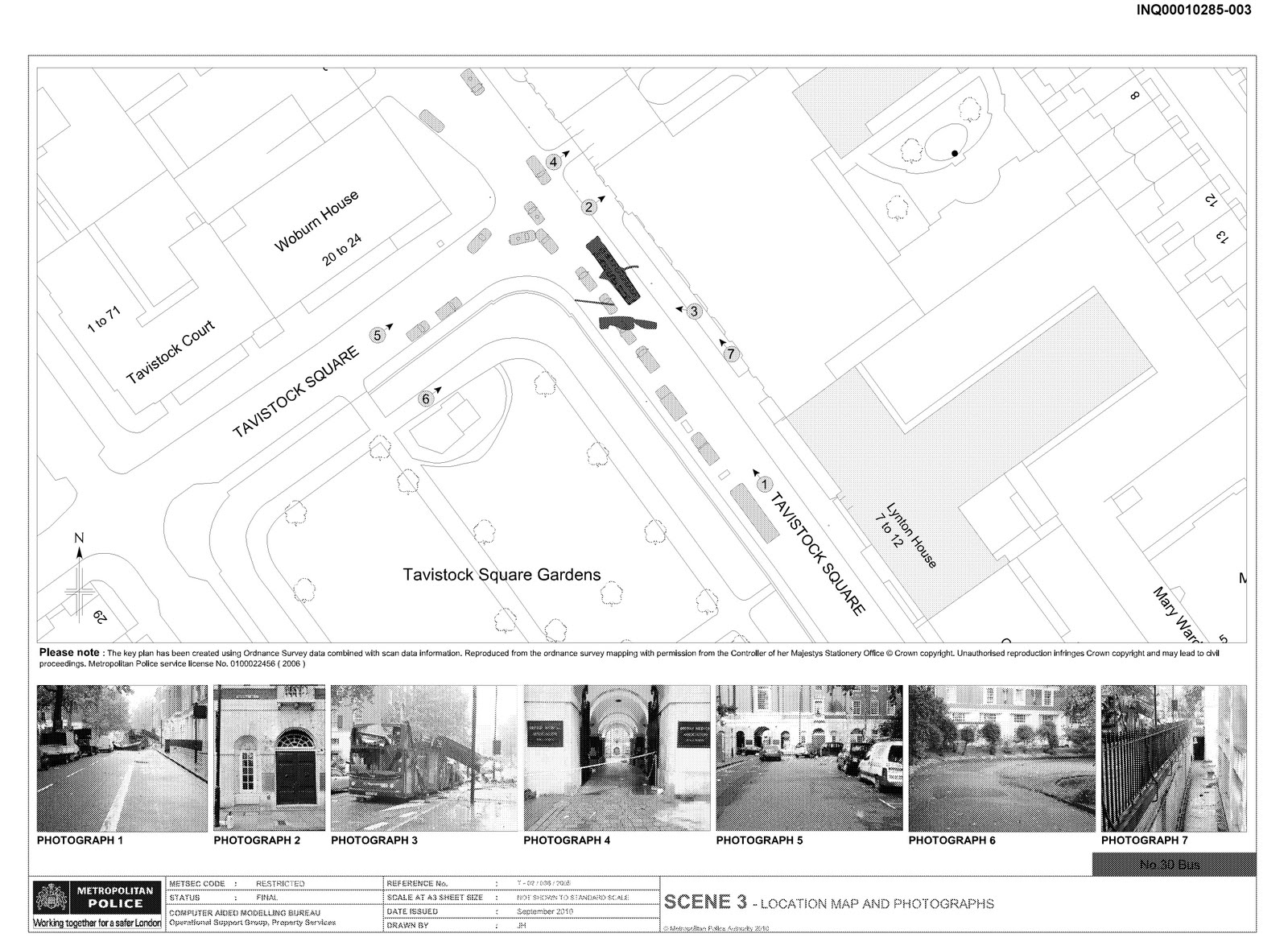
Regina Cope is number 14 and Regina Friel number 10 in this diagram

Curiously neither of these passengers were called to give evidence, nor were witness statements from them read out! Nor were any witnesses from Lynton House who aided the survivors called or had statements read and Lynton House is hardly mentioned during the 7/7 Inquests!

One of the passengers who did give evidence Gary O'Monaghan recalled how after getting off the bus “I landed on my feet and just started to run” [14 Jan p36:13] and “This is perhaps why I ran away fearing it would explode again” [p36:21]. He is, however, almost certainly the 'Gary' who appeared at The London Assembly 7th July Review Committee in 2006 and stated (page 202) that he had gone into the 'E.C.Harris Building' (which is Lynton House) and then declared (page 208) “I was staggered when I left. The whole foyer of the building was full with people on trolleys like that, all bandaged up”.

Interestingly another witness at the GLA Inquiry 'Beverli' who wasn't on the bus but worked in Lynton House for a consultancy firm that was involved with Olympic delivery recounted how she and her colleagues “were told as staff, that we were banned from talking to anyone - particularly the press, which was an immediate dismissal offence - police, or anything regarding the experience”(page 35).

An official reference to Linen(sic) House does appear in the document INQ10129-2 which was called up by Mr Andrew O'Connor QC on the morning of 19th January [p12:16]. This is a copy of a police log which, timed at 10:10:55, states “have 10 inj'd persons at Linen Hse 7-12 Tavistock Sq, WC1”. Possibly by coincidence, possibly not, Mr O'Connor a short while later [p36:21] whilst questioning WPC Kerslake, states incorrectly “The BMA building is where you see the words Lynton House, that's the name of the BMA Building”!!

A not dissimilar exchange can be found in the transcript for the afternoon of the 19th January, Michelle Du-Feu: ”At the time he (the security guard) was actually in the building immediately before that. I think its called Lynton House or something” [p6:22]. Mr.Andrew O'Connor: “I see. In any events the BMA building's on that side of the pavement. We know where the bus was just opposite” [p6:24].

[Editor: Lynton House was presented with a plaque from the Metropolitan Police almost immediately after, this report is date 19/07/05: "The lobby of Morley’s building, Lynton House, became a makeshift hospital for the wounded immediately after the attack. Some of the firm’s own first aiders were among the first on the scene after the bus was devastated by the bomb. At least another 20 businesses occupy space in Lynton House, and the Metropolitan police has presented a plaque for the building’s lobby area commemorating the help given by staff working in the building." source]

We can only speculate at the reason for all the official coyness. Could it be the numbers involved?

'Jaki Turner' wrote on the BBC London blog 'BBC London Bombings - 7 July: One year on': “Last year at this time I was working at Tavistock Square when the bus went up next door and we the first aiders at Lynton House dealt with some 35 people hurt on the bus”.

If we add those 35 to the casualties dealt with in the BMA Building and the County Hotel as well as the BTP Headquarters, Great Ormond Street Hospital, The Tavistock Hotel, Tavistock Court and the offices of the Rev Deborah Hodge, the three who PC Walker put into civilian vehicles and the five who Walter Hayden set off to UCL Hospital with and then factor in the “at least 13 patients” that Ambulance Officer Williamson had at Tavistock Square south and “the number of people with minor cuts and injuries” Dr David Tovey reported as being outside the back of the BMA building there will be a total considerably in excess of the 47 non-fatalities on the bus!

Which in turn raises other interesting questions!!

*David Minahan was by occupation a claims investigator for an insurance company and later a leading firm of solicitors and has experience of "forensic" matters. David was also the National President of a major Trade Union (MSF now merged with the AEEU to form Amicus). David researched and wrote the London Bombings Dossier published on the J7 website and says he is convinced that there has been a massive cover up and campaign of disinformation about the events of 7/7.

Saturday, 5 February 2011

SIMply wrong

Back in October 2010, when DS Stuart first gave sworn testimony to the 7/7 Inquests (J7 analysis here) he told us that a phone belonging to MSK was found at Edgware Road:
Q. In particular, investigators found in the wreckage a phone subsequently determined to belong to Khan?
A. That's correct, sir, yes.
Q. When that phone was examined, did it have any readable data on it?
A. No, sir, it was damaged beyond --

DS Stuart then discussed the calls made and received on this 'phase 4 operational phone' produced in a schedule entitled 'Draft schedule of all calls between MSK, Tanweer, Hussein and Lindsay attributed phones 270605 - 070705, and all calls in the same period to/from phones used by the four on 070705'.

The details for the phone used by Khan and described as 'a phase 4 operational phone' ends with '254'. Its recovery and connection to Khan was described to Hugo Keith QC by DS Stuart:
A. The handset for that phone was discovered at the Edgware Road scene where Mohammed Sidique Khan's body was recovered. DNA from Mohammed Sidique Khan was recovered from the handset as well. The phone was routinely cell-sited in and around his home address. It was cell-sited in Luton on the 7th where we know from CCTV Mohammed Sidique Khan was. It only ever rang the other three. It was never rung by another number attributed to Mohammed Sidique Khan.

DS Stuart then claims that previous operational phones contained no suspicious contacts, preferring to claim that each of the 4 phase 'operational phones' were only called by the 4 accused in connection to each other, the caveat to that being calls to car hire companies and the 3 men that were tried in the Theseus trial. Answering question from Mr Patterson QC, we gather that:
Q. Have you, Sergeant, analysed the contacts made between the earlier phones and numbers being used by the four men and other people outside that group of four?
A. Yes, sir.
Q. Did those enquiries lead you to any suspicions as to other contacts that might have led to suggestions that other people were involved or assisting the four men?
A. There have been prior court cases in relation to that, sir, yes.
Q. I'm aware of that, and three individuals in particular, but focusing just on the days leading up to 7/7, any suspicious contacts in any of the telephones in that period of time?
A. No, this is an accurate schedule of that, of all the contacts.
Q. Yes. That's not quite an answer to my question. One issue that arises is whether there's evidence that the four bombers were assisted in any way, either on the 7th itself or in the days leading up, and one way we can analyse that question is by focusing on telephone contact. Any suspicious contacts on the 7th or in the days leading up with others outside of the group of four?
A. No, sir, not that I'm aware of, no, sir.


This point is further confirmed by counsel to the MPS, Max Hill, in his questioning of DS Stuart:
Q. Then just looking at the entirety of this schedule, so the period from 27 June to 7 July, are you saying that this is a complete operational picture in terms of telephones in the hands of all four bombers throughout the period 27 June to 7 July?
A. Operational, yes, sir.
Q. In answer to earlier questions from Mr Patterson, it is right that at an earlier stage there was what might be called some operational telephone use connected to those who became the subject of the Theseus trials.
A. Yes, sir.
Q. The three men who stood trial in 2008 and 2009.


To sum up what we knew in October 2010, a single phone, Khan's 'phase 4 operational phone 254', was found at the Edgware Road site, the phone had no recoverable data, the schedule released shows all calls made and received on operational phones between 27/08/05 and 07/07/05. The only suspicious calls made and/or received on operational phones were those connected to the two Theseus trials held in 2008/09.

J7 contacted the Inquests to clarify some of these details when we became aware that DS Stuart would return to give further testimony to the 7/7 Inquests on 2nd February 2011. One of the issues we asked for clarification on was:
During the questioning of Detective Sergeant Mark Stuart, in sworn testimony, he stated that there was no recoverable data from a phone 'determined to belong' to Mohammad Sidique Khan:

However, news articles covering the first and second trials of the accused Waheed Ali, Sadeer Saleem and Mohammed Shakil claim that a phone recovered from Edgware Road contained phone numbers attributable to the accused and a text message sent from Waheed Ali to Khan:

Flewitt said the strength of Ali's relationship to Khan was demonstrated by a text message Ali sent to the July 7 ringleader on December 7 2003.

It read: "Gates of memories I will neva (sic) close. How much I will miss you no one knows. Tears in my eyes will wipe away but the love in my heart for you will always stay."

In the remains of Khan's mobile telephone, recovered from the debris at Edgware Road, were numbers "attributable" to Shakil, saved as "SHAXMOB",and Saleem, saved as "Sads", the jury was told.

Evidence in the trial included details of the remains of Mohammad Sidique Khan's phone, found amid the wreckage of his Edgware Road blast that killed six people. His phone included a number tagged "SHAXMOB", attributable to Mohammed Shakil, and another entry, "SADS", referring to Sadeer Saleem.


He was so close to Khan a text message was found on the suicide bomber's mobile phone in the rubble of the Edgware Road blast. It read: “Gates of memories I will neva (sic) close. How much I miss you no one knows.Tears in my eyes will wipe away, but the love in my heart for you will always stay.”

When DS Stuart's returned to give further evidence on Wednesday 2nd February he was asked the following by Hugo Keith:
Q. May I, before I move away from Khan's operational phones, address one particular point? An organisation that has been following this issue has expressed a certain degree of confusion as to which phones were recovered where, and perhaps I could just clear up that particular confusion, if it exists. In relation to MSK's phone, 826, the handset and SIM were found, were they not, inside the tunnel at Edgware Road?
A. That's correct.
Q. That's the third phone on the page?
A. Yes.
Q. As a result of the SIM card being found, was it possible to retrieve any of the data on that phone?
A. There was no data that could be recovered.
Although it was sent off for examination, they couldn't extract any data for it.
Q. What about in relation to the last operational phone, 254, which was also, I think you told us last year, recovered from Edgware Road --
A. Yes, sir.
Q. -- or at least certainly the handset was recovered and I think you told us that it was damaged beyond repair?
A. It was, sir, and for the same reason, they couldn't extract any data from it either.
Q. Where Khan sent or received texts, therefore, particularly at the time of the use of the last operational phone, how were you able to retrieve data evidencing the sending or receipt of texts?
A. The actual sending would come from the call data. The context or the content, we would rely on downloads for whichever phone it was sent to or received from.
Q. So are there a number of routes by which data can be retrieved, even if you don't have the original SIM card?
A. Yes, sir.

Not only did Keith take this opportunity to claim that not only 'a phone' was found at Edgware Road, as stated by Stuart on 14th October, but in fact, two phones were found in the tunnel. Khan's phase 3 & 4 operational phones, 826 & 254 respectively. Yet it seems that only the handset and not the SIM of the 'phase 4 operational phone', the sole phone described in the schedule discussed when Stuart gave his original testimony, was recovered. No reason is given for Khan's missing SIM card.

Ms Gallagher, counsel for the bereaved, also questions DS Stuart on the question J7 posed in relation to the data extracted from Khan's phone that was referred to in the Theseus trials:
... Could I just start by dealing with this issue of confusion? Mr Keith, when questioning you, referred to an organisation having expressed confusion about your statement on 14 October about there being no readable data from the phone at Edgware Road that was recovered at Edgware Road, and you were taken to those two phones. It's [INQ11176-2]. So both the phone number ending 826 that was recovered inside the tunnel at Edgware Road --
A. Yes.
Q. -- and I think you've said the SIM card was found and sent off but there was no readable data?
A. That's correct, yes.
Q. And phone number 254 also recovered from Edgware Road mentioned at the bottom of that page and you said, for the same reason, no data was recoverable there?
A. The handset was recovered and it was -- no data could be --
Q. Mr Keith said, "Well, how do we have information about the exchange of text messages?", and you made reference to obtaining call data. So it's possible to obtain information about text messages without extracting it from the hardware itself, from the SIM card of the telephone?
A. Yes, there will be a record of the sending of the text on the call data that we can recover from the phone companies.
Q. But Detective Sergeant, that's just information about the sending and receipt of texts. It's not information about the content?
A. The content you would only get if the phone that either received or sent the text to the damaged phone was itself recovered and examined and we could derive data from it.
Q. So the comms data can't give you the content, that's only possible from hardware of one or other phone. So it's not possible to recover information such as contact details, so telephone numbers that are saved and so on, through comms data?
A. No, that's correct.
Q. Detective Sergeant, I think the difficulty is that your answers won't have cleared up the confusion, because the reason that the confusion has arisen is that there were a number of news articles, public at the time of the Theseus trial, which referred to the actual content of text messages recovered from one of those phones and, indeed, I think publicly there's some information with links to those news articles. But, in fact, we can go one step further because, of course, we've got the opening from counsel in the Theseus trial -- the reference is [INQ105680-12]. It's paragraph 64 and it says: "Among the debris at the scene of the Edgware Road bombing the police found part of a mobile telephone belonging to MSK. In the memory of that mobile phone was recorded a mobile telephone number attributable to Shakil ... and a ... number attributable to ...Saleem ..." Then paragraph 65, I don't think we need it on screen, but for your reference, my Lady, that includes the content of a particular text, also recovered from that.

There is then some discussion on how the texts between Lindsay and Khan were recovered and it is established that these were accessed from Lindsay's phone, then continues:
Q. The reason it's important to do this, obviously, is, as you're aware, a number of people are following these proceedings very closely. There's been some concern expressed about this issue, so it seems sensible to just put it to bed. If there's a simple answer, let's just have it and it will be on the public record.
A. Yes, not at all. [ibid p35:5 on]
-------------
Q. Detective Sergeant, just to clarify it, if we could go back to [INQ105680-12] at paragraph 64 , when, in the opening to the Theseus trial, as was widely reported, it stated there that this information was recovered from that mobile phone found at Edgware Road, is that simply wrong?
A. Yes. [ibid p39:22 on]

Simply wrong? We can add this 'simply wrong' to the litany of errors anomalies and inconsistencies that J7 have detailed, so far, over the 15 weeks of the 7/7 Inquests. The fact that 'simply wrong' evidence can be used in an attempt to convict 3 men, all found innocent, who faced up to 40 years in prison isn't just 'simply wrong' it's 'simply appalling'.

More 'simply wrong'

The first page of a schedule detailing purchases from hydroponics shops was released, beginning on 22nd February 2005, claiming that Tanweer contacted Huddersfield Hydroponics on a phone 'atributed to him' which was cell sited within a 2km radius. Keith claims that 'operational phone usage begins around the time that hydrogen peroxide purchases are made'. [ibid p15:9 on] Yet DS Stuart gives the precise date and time for the first use of an operational phone (phase 1) for Tanweer as 25 March at 18.06, over a month after the supposed first purchase of hydrogen peroxide [ibid p11:14 on]. Simply wrong.

Pakistan calling

After claiming that no 'suspicious calls' were made to or from operational phones in DS Stuart's original testimony, the updated schedules show calls made to Khan's 'operational phones' from various phone kiosks in Pakistan, mainly from the Rawalpindi district. 'No suspicious calls' (simply wrong?) transforms into 'so many suspicious calls':
.. question of calls from Pakistan, if we just screen down, please, to page 11 [INQ11177-11] of the exhibit, we can see in the bottom half of the page there a number of calls from Pakistan?
A. Yes, sir.
Q. In particular from Rawalpindi, so 9 May, 10 May. Over the page to 12 May, page 12 [INQ11177-12] of the document. Then moving forward to 14 May on page 14 [INQ11177-14] , there were a great deal many calls from Rawalpindi on that day, we can see there, all to MSK, the original schedule is in red, and I needn't go through the schedule to the later dates, but are there further calls on 19 May, 31 May and 2 June?
A. Yes, sir.
Q. There appeared to be a substantial number of calls in that period from the middle of May to the beginning of June, and then, again, were there further calls from Pakistan, right at the very end, just a matter of days before the bombs are detonated on 7 July, on 2 July in fact?
A. Yes, sir.
Q. Did you assess that these calls, therefore, were probably connected to some guidance or some means of communicating information concerned with the manufacture of the bombs and then, ultimately, their detonation?
A. Yes, I think they had to be, sir. [ibid p20:1 on]
Not just suspicious calls but apparently 'bomb-making suspicious calls' - did DS Stuart think these unworthy of mention during his first appearance at the 7/7 Inquests? Perhaps the testimony given by Clifford Todd, principal forensic investigator at the Forensic Explosives Laboratory the previous day, contains the reason:
Q. The technical expertise required to construct either the initiating device or the main explosive device, was that of a particularly high order, or could those four men -- none of whom it seems had any particular skills in chemistry -- have carried that out under a certain degree of guidance or instruction themselves?
A. Yes, they would have needed some -- certainly initial guidance or instruction, I believe. I don't think that -- my comment about them dealing with this and doing this in isolation is intended to make a distinction between four people with no experience of bomb-making, suddenly between themselves, and only between themselves, deciding to come up with a bomb plot such as this, make the devices, and go and set them off, certainly without extensive practice themselves. That's not really feasible. They would need some detailed instruction and some practice, almost certainly, at doing this. So that's what I was trying to get at in my comment about having some outside help. There must have been something more, some -- they must, at some point, have had some advice.
Q. Once the instructions or the guidance had been provided, and perhaps alongside a certain degree of training, perhaps abroad, would they have required there to have been a specialist bomb-maker or a chemist present in Alexandra Grove for bringing their plot to fruition?
A. No. I should also perhaps say that these were -- these devices were entirely unique. Certainly the hydrogen peroxide mixed with a fuel such as pepper were entirely unique within the UK for sure and, as far as I know, worldwide as well. At the time, there would have been plenty of information on the internet about how to make bombs of various descriptions, and certainly now, if you were to look, probably you will find information about devices of this particular type. But at that time, if it was the case that four people just decided to do this with no prior experience, they probably could have got enough information off the internet, but it would be extremely unlikely they would have come up with this particular design. They would have most likely come up with a design already known and spoken about on the internet, which, to the best of my knowledge, that wasn't there at that time.
Q. So this supports your overall view that the construction of these devices could only have been undertaken with guidance and instruction from elsewhere --
A. Yes, correct.

Q. -- and obviously persons unknown. The process is not, regrettably, hugely complex, but it is quite a sensitive process, is it not, in terms of getting the ratios and the mixtures right?
A. Yes.
Q. Is it your view that the paraphernalia in Alexandra Grove indicate that a great deal, unfortunately, of time and effort appears to have been dedicated to getting the ratios right and to making these devices work?
A. Yes, both the time and effort has been taken and the understanding there of what they need to do to get it right.

The 'suspicious Pakistan phone calls' may go some way to answer Clifford Todd's amazement that the 4 accused were able to construct viable devices, of the like never seen before or since, without considerable expertise. What it doesn't answer is: How did they know which of the devices were viable and which were 'simply wrong'?


J7 will return to analysing the vast amount of evidence released over the last week in relation to Alexandra Grove and bomb making. In the meantime..

As Hugo Keith and Ms Gallagher correctly described J7, we are an organisation that is keeping a close eye on these proceedings. In the absence of a jury to ask questions, to note the many inconsistencies, it is up to we the ordinary people who are not following these proceedings for catchy headlines to sell newspapers, to examine the evidence presented to the 7/7 Inquests and ensure that we are all informed when this evidence is 'simply wrong'.

Monday, 22 November 2010

The Conspirators and the "Conspiracy Phones"

This previous post raises an interesting question regarding quite how the four accused men had avoided detection to such an extent that the security services had no idea of their alleged plans. What with travel tickets, handwritten documents laying their plans bare and receipts recovered both from the homes of the accused and the Alexandra Grove 'bomb factory', their behaviour suggests that these men were not in the least bit concerned about their alleged plans being discovered yet the narrative tells us 'Khan was worried about being under surveillance during this time.

'This time' plainly refers to the supposed planning of the events of 7/7, since just above this statement, it is also written,
Other things suggest discipline and meticulous planning with good security awareness including careful use of mobile phones and use of hire cars for sensitive activities associated with the planning of the attacks.

The 'careful use of the mobile phones' was explored on the 4th day of the inquests during the testimony of DS Mark Stuart of Counter-terrorism command. DS Stuart confirmed that 'a certain number' of phones were recovered. What we also discover from DS Stuart, is that the police referred to the phones the accused men were using that day as 'operational phones' (as opposed to their personal phones) - which Mr. Hugo Keith QC later interchanges with the intriguing term 'conspiracy phones'.

These phones are claimed by DS Stuart to have been a way to 'avoid detection' by being changed on several occasions:
A. [DS Stuart] There were a series of operational phones. The earliest operational phones began in May, the middle of May, 2005, sir.
Q. [Hugo Keith QC] How many times were the phones switched or how many times were a new set of operational phones introduced into their usage?
A. For three of the subjects, four times, you're looking at data for the last, fourth, operational phone. For Lindsay, there were three, sir.
DS Stuart confirms later in the proceedings that the total number of 'conspiracy' phones used by the men was 15. One could argue that if a phone is changed four times, as three of the men are alleged to have done, this equates to five phones in total each - meaning that with Lindsay's four phones, the total amount of changes stated equates to 19 phones. This may seem a trivial point, but it is indicative of the confusing nature of DS Stuart's testimony. Another example of this is his account of the recovery of Khan's 'conspiracy' phone:
Q. In particular, investigators found in the wreckage a phone subsequently determined to belong to Khan?
A. That's correct, sir, yes.
Q. When that phone was examined, did it have any readable data on it?
A. No, sir, it was damaged beyond --
Q. Officer, could I ask you to keep your voice up a bit?
A. Sorry. No, it was too damaged to recover data from.
Q. So when that phone was examined, it wasn't possible to extract any relevant information from it?
A. No, sir.
Q. Was there also recovered from the Russell Square tunnel a phone subsequently determined to belong to Lindsay?
A. Yes, sir.
Q. When that phone was recovered, was it found to have information on it?
A. It was, sir, yes.

So very early on, we find that no data could be extracted from Khan's phone, which was recovered from the Edgware Road site, due to the damage it sustained. The implication thereafter is that the only way any data relating to Khan can be examined is through looking at incoming calls or texts on the other phones recovered from the day, in particular, the phone attributed to Lindsay, from which information had been extracted. However, a little later in his testimony, DS Stuart seems to contradict his earlier statement:
Q. Could I just run very briefly through why you are so sure that these phones relate to these people? In relation to Khan and his operational phone ending 254, were there a number of pieces of evidence which demonstrated that that phone was indeed his?
A. Yes, sir.
Q. Could you very briefly, please, summarise why that conclusion was reached?
A. The handset for that phone was discovered at the Edgware Road scene where Mohammed Sidique Khan's body was recovered. DNA from Mohammed Sidique Khan was recovered from the handset as well. The phone was routinely cell-sited in and around his home address. It was cell-sited in Luton on the 7th where we know from CCTV Mohammed Sidique Khan was. It only ever rang the other three. It was never rung by another number attributed to Mohammed Sidique Khan. That was the principal evidence, sir.

How could this data regarding Khan's phone be known if it wasn't extracted from the phone which DS Stuart had earlier stated 'was too damaged to extract data from'? DS Stuart does not enlighten us to any alternative method used to gain access to the phone's data.

Curiously, DS Stuart never states whether or not Shehzad Tanweer's phone was also recovered in the same way as the other three, at the scene of the explosion at Aldgate. We should note claims by both the narrative and Hugo Keith QC in his opening speech to the Inquests, that Tanweer had lost his mobile phone on the evening of 6th July, during a game of cricket.

However, DS Stuart confirms that a call was made at 00.03.59 on July 7th 2005, from Khan to Tanweer. If Khan's phone is too damaged, then we must assume that this particular data came from Tanweer's phone. But Tanweer lost his phone on the evening of July 6th ; we cannot know if it was his personal or 'conspiracy' phone, we cannot know if he or someone else - found it, and cannot know if a phone attributed to him was found at Aldgate. We further cannot know from which phone this information was extracted as we are not privy to the contact schedule cited by DS Stuart.

When explaining how the 'operational' number for Tanweer was attributed to him, DS Stuart tells Mr. Keith:
This was a number which was provided by Shehzad Tanweer on the rental agreement for the Nissan Micra subsequently left at Luton train station. Again, it was only rung by the other three and not by Tanweer himself. Generally cell-sited in the area of his home address.

So in contrast to the identification of the other three phones, which occurred due to their being recovered from the respective blast sites, Tanweer's 'conspiracy' phone number is identified because he provided it to the car hire company which supplied the Nissan Micra. Why should this be?

The car hire company provides another example of contradicting the idea that attempts were made by the men to avoid detection; Tanweer provided the First 24-Hour Car Rentals Limited with his family home address, confirmed in the statement of an employee of the company who called round to the Tanweer home when the car had not been returned as agreed.
By today, Tuesday, 12th, I was very concerned at the whereabouts. I decided to visit his home address and I went to the vicinity of the address and I saw a police cordon. Having explained why I was there I then provided the rental agreement.

In another statement, it is revealed to the Inquests that another First 24-Hour Car Rentals employee had attempted to contact Tanweer on 7th July, despite the fact that his rental agreement was until 8th July. Why would the car hire company attempt to contact Tanweer the day before he was due to return the car? Again, this is not revealed. The statement from the car hire company contradicts Hugo Keith's claim that they rang Tanweer's phone on 7 July, although the unreleased schedule showed this call:
[First 24-Hour Car Rentals] "Following 8 July, when the vehicle had not been returned as agreed, I rang the mobile number given by him on at least two occasions. However, the phone was off. I can only say, if I saw the man again, I would definitely recognise him."
[Hugo Keith] My Lady, we know that the last entry on the schedule prepared by Mr Stuart at your direction is that there was a call on 7 July, in fact, two minutes to 3 from First 24-hour Car Rentals to Tanweer's number.

Neither was the cell siting for Tanweer's mobile phone disclosed, which would have identified whether this phone was at Aldgate or, if lost, at least identified the location.

DS Stuart had also disclosed that the contact schedule only relates to calls made from 27 June 2005 onwards:
Q. Notwithstanding the fact that there were many thousands of calls made to and from any number of potentially relevant phone numbers, you prepared a schedule showing all the calls between the four men from 27 June onwards?
A. That's correct, sir, yes.
Q. In essence, the most relevant days leading up to the events of 7 July?
A. Yes, sir.

It isn't stated at which point the accused are supposed to have switched to their final set of 'conspiracy phones'; only that this occurred in the last few days before 7/7. Later in the proceedings, Ms. Caoilfhionn Gallagher, representing bereaved families, pushes for analysis of all the 'conspiracy' phones. DS Stuart may yet be called back to give further testimony on these, and we may yet receive clarification regarding how (or even if) Tanweer's phone was recovered.

Germaine Lindsay was said to have purchased and originally registered the phones, then transferred them to each of the others at a later time. DS Stuart makes it clear in his answers that although there was 'some slight mixing' in the use of the 'operational' phones, in that personal phones may have been used to ring an 'operational' phone number, by the time the accused were using their final set of phones, they were used solely for 'operational' purposes or calls to service providers.

Again, the implication is that this, along with clarification by DS Stuart that the use of the phones showed that the men were taking care over communications by buying prepaid unregistered phones and changing them regularly. Yet strangely, the behaviour of Hasib Hussain regarding his phone contradicts this assertion. Having earlier described how the top-up card for his 'operational phone' was found at his home address and the SIM card holder in a bag upon which Hussain's fingerprints were found, under questioning by Max Hill QC, DS Stuart details how the police knew about Hussain's personal phone:
Q. Secondly, in relation to Hasib Hussain, you analysed data relating to mobile number ********805, and two points again in relation to that. Firstly, that number was not used by Hussain on 7 July?
A. No, sir.
Q. But, secondly, through analysis of items recovered, including a SIM card, a mobile phone SIM card, found at Tavistock Square where Hussain's body was found, a download -- in other words, interrogation of the information held within that SIM card -- showed the 805 number saved within the SIM card under the title "My number"?
A. Yes, I believe that's the case.
Q. That goes towards attribution of that as a personal phone for Hussain, but one that you can say was not used on 7 July?
A. Correct, sir, yes.

If Hasib Hussain was only using this phone in the 'last few days' leading up to 7th July, then why take the trouble to program in his own personal number? Why would someone trying to 'avoid detection' do this anyway? Moreover, Hussain's personal phone was found by his brother, Imran, to contain not only Lindsay's number, but that of the keyholder for 18 Alexandra Grove, Dr Shakir Al Ani. Why program these numbers into his personal phone, if he was also in possession, at various times, of four (or more) 'conspiracy' phones. When asked by Lady Justice Hallet how the police were able to distinguish between the personal phones belonging to each men and the 'conspiracy' phones, in terms of usage, DS Stuart responds:
There was a distinct difference between the usage of the two types of phone. The personal phones all appeared to be unrelated, a lot of different people rung by them, but the enquiry showed that they were people that were known, historical friends and family. So that's why I can't remember there being anything which jumps out as being operational from a non-operational phone, my Lady.

If this is the case, why did Hussain have the 'operational' numbers found on his 'non-operational' phone by his brother, which in turn, according to the Daily Mirror, led him straight to the Alexandra Grove 'bomb factory' If Hussain was seriously trying to cover his tracks, he had made a pretty poor fist of it.

In summary, we've learned the following from DS Stuart's testimony regarding what Hugo Keith prefers to call the 'conspiracy' phones:
  • Khan's 'conspiracy' phone was too damaged to extract data from, yet counter-terrorism investigators appeared to have managed to do just that.
  • We do not know whether Tanweer had a 'conspiracy' phone with him on July 7th, because although DS Stuart mentioned calls being made from other phones to the phone attributed to Tanweer, he never mentions calls being made from that phone, nor does he mention that his phone was found at the Aldgate scene in the same way that the phones attributed to the three other men were found at the other blast sites.
  • We know that Tanweer lost his phone on 6 July but we do not know whether this was his personal phone or 'conspiracy' phone, or whether he found it before the next day. The cell siting of the car hire company call on either the 7 July according to the schedule or the 8 July according to the car hire company, would reveal the location of this phone but was not disclosed to the Inquest.
  • The four accused were trying to avoid detection to such an extent that they routinely left incriminating evidence, either in their own homes or the Alexandra Grove flat, provided a genuine address even when using a 'conspiracy' phone to arrange car hire and Hussain in particular, found a way of leading detectives straight to his personal number from his 'conspiracy' phone.
  • There may have been 15 or 19 'conspiracy' phones in total, but we have only been provided with testimony with the final 4 phones used. We were not allowed to see the contact schedule; this was "not for publication".
  • DS Stuart defines the "trade craft" use of the "conspiracy phones" thus: "Taking care over your communications, buying prepaid unregistered phones, changing them regularly to avoid detection ultimately" yet later states that Tanweer's phone, at least, was purchased, and registered, by Lindsay using a false name. Why would Lindsay go to the trouble of registering the phone at all, when an unregistered phone could so easily be purchased with a pre-paid SIM?