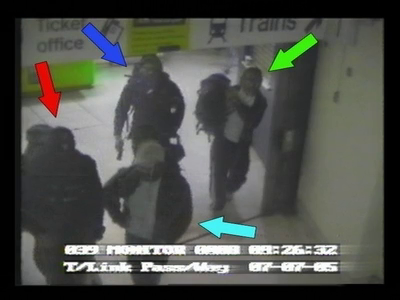
The Report of the Official Account of the Bombings in London on 7th July 2005, published on 11th May 2006 (hereafter known as The Narrative), made it abundantly clear that the public should consider media reports regarding the so-called “fifth man” groundless. It stated:
“There was at the time of the attacks, reports of a “5th bomber”. It was thought, because of witness statements and CCTV, that there was a “5th man” with the group travelling down from Luton. Inquiries showed the individual was a regular commuter and he was eliminated from the inquiry. Also in the period immediately following the attacks, one man was arrested in connection with the investigation but he was released without charge. In subsequent weeks, a further man who had claimed to be the “5th bomber” was also arrested and later charged with wasting police time. There is no intelligence to indicate that there was a fifth or further bombers.”
In the opening week of the 7 July Inquests, we have heard from the witnesses mentioned above who claim to have seen a fifth (and in some cases a sixth) man - and the Home Office Narrative's claim that the man was a “regular commuter” seem odd at best – and misleading at worst.
The witnesses in question include Sylvia Waugh, who believes she saw the men outside the flat in Alexandra Grove, Leeds where it is claimed the bombs allegedly used on July 7th 2005 were manufactured. There is also Susan Clarke, who believes she saw the men in the car park at Luton Station. Joseph Martoccia was the witness whose statement to the police in July 2005 regarding his believed sighting of the men at King's Cross station was mutated by the media into a CCTV image, so successfully, that even a former newspaper editor appeared to believe he had actually seen such an image. Yet, as detailed in this previous post, no such image ever existed. This however hasn't stopped it being described as "iconic" and even the Press Complaints Commission agreed that an image that doesn't exist and hasn't been seen by anyone is still perfectly entitled to be described as an "iconic image".
Sylvia Waugh, who says she saw the men in the early morning of 7 July 2005 in Leeds, gave four witness statements to the police. Under oath at the Inquest, Mrs Waugh claimed that she regularly saw at least 6 people entering and leaving 18 Alexandra Grove. Significantly, Mrs. Waugh states that she finds it difficult to discern differences between 'coloured people'. Indeed, after stating on four occasions during her testimony that Jermaine Lindsay, who was, according to mobile phone evidence and the official 'narrative', some 160 miles away at the time, this difficulty does seem to be the case. However, despite this, it seems reasonable to assume that Mrs. Waugh is able to count:
Q. You remember a white car. Might that have been car B that you put on the map for the police?A. It could have been.Q. What about the other car, what colour was the other car?A. Like a bluey colour.Q. There were a group of men. Can you help us as to howmany you think you saw?A. At least six.Source: Transcript, 13 October 2010
A few moments later, Mrs. Waugh is reminded that she told police she had seen four men getting into what seems to be the Nissan Micra in which Mohammad Sidique Khan, Shehzad Tanweer and Hasib Hussain travelled to Luton from Leeds. She recalls seeing six men in total, and two cars. The other car, according to Hugo Keith, counsel to the inquest, has never been traced. Mrs. Waugh's testimony is very confused; on more than one occasion she denies what she had said in her police statements and at one point she denies something she was recorded as saying several minutes previously whilst under oath. However, her claim to have seen four men getting in the Micra, and six men in total, is interesting when compared to the statement Susan Clarke gave to the police in July 2005, which was read out in part whilst she was questioned under oath during the inquests:
Q. [Mr Patterson] "One car had one or two males in it. The other, a lilac-coloured Nissan, had four males leaving it, all carrying rucksacks. When asked, she described all the males as not white."A. [Susan Clarke] He then goes on to say that you handed him the piece of paper that you've told us about.Q. So pausing there, is that an accurate note of what you told the officer on that Tuesday?A. As far as I remember, yes.Q. So although today you've told us that you thought that it was four, possibly five, men associated with those two cars, within days of the incident, the very first time you spoke to the police you were saying that it was two men from one of the cars, four men from the other car, all carrying rucksacks?A. Yes.Source: Transcript, 13 October 2010
Joseph Martoccia, a commuter who believes he saw the accused at King's Cross mainline station on the morning of 7th July 2005, also said he saw six men:
Q. Have you marked X as the spot where you came across a group of men?A. Correct.Q. Do you recall how many there were?A. Yes. At the time, I said between four and six.I wasn't entirely certain of the number.Source: Transcript, 13 October 2010
Mr. Martoccia goes on, however, to say that the men caught his attention because they were in a huddle. It was this behaviour that led him to initially deduce they were probably a sports team.
Interestingly, although Mr. Martoccia contacted the police the following day, he was not asked to identify the men from photographs until almost a year later, a somewhat odd approach in what was termed by Sir Ian Blair as "the largest criminal inquiry in English history". When shown a picture of Jermaine Linsday during his testimony to the Inquests, Martoccia stated that he did not remember seeing him. Moreover, Martoccia said that the man he saw heading towards the Piccadilly line – who, one would presume on the basis of the official 'narrative', would be most likely to be Lindsay, who stands accused of causing the explosion on the Piccadilly line train – was instead Hasib Hussain; the man accused of being responsible for the number 30 bus incident.
Detective Inspector Kindness of Scotland Yard's Counter-terrorism Command gave an intriguing response when specifically questioned by Mr. Gareth Patterson, representing four bereaved families, over the number of men witnessed:
Q. You're probably aware, Inspector, of why I'm asking you these questions. Presumably you were told that there's a witness, Susan Clarke, who told the police quite early on that there may have been more than four people in and around those two cars. Were you aware of that? Did you look for the number of people around those cars?A. Yes, at the time, when we were viewing the CCTV, we were comfortable with the amount of people that were there and that we'd managed to track them to the position where we got decent CCTV images that we could say, yes, there are that number of people.Source: Transcript, 14 October 2010
Shortly after this, Mr. Patterson is interrupted by Hugo Keith QC, who expresses concern over his questions “because they do appear to me to be designed to leave the impression that either there was another person at large or that in some way the investigation has been inadequate or has not properly pursued leads available at the time.” After further admonishment by both Mr. Keith and Lady Justice Hallet, Mr. Patterson is able to continue:
MR PATTERSON: If we pause it now, perhaps. Can we see four figures walking off, Inspector?A. Yes, we can, yes.Q. Is there a figure who hovers and lingers between the two cars for a period of time?A. Yes, there is a person there, yes. I think that's the person that exited that vehicle that just arrived.Q. Was that something that was investigated and looked into to see where that additional fifth person --A. The individuals around the car were -- their movements were assessed, yes.Q. Is that something that you dealt with or that somebody else dealt with?A. I didn't personally follow this individual away, no.Source: Transcript, 14 October 2010
Later that same session, Ms. Caoilfhionn Gallagher, representing five bereaved families, continues a similar line of questioning:
Q. You said in your evidence earlier: "At the time of viewing the CCTV, we were comfortable with the amount of people that were there." That's for your reference, my Lady, page 180 of thetranscript today, lines 10 to 14. That was referring to that footage of Luton rail station that we've referred to earlier. Can you just go to page 2 of this document, Inspector?A. Yes.Q. Can you see the entry at 7.19 about halfway down the page? This is an entry by DC Stephen Bain who was viewing it on 10 or 11 July. Can you see at the end of that entry at 7.19, after he describes four persons at the rear of the vehicle, he says: "Fifth person remains at vehicle, movement between both, fifth person towards Luton station, distant view." Then a little further down the page, 7.23: "Fifth male through ground level barriers from car park", and there's continued references to the fifth male there, so two more entries at 7.23. So did you discuss with DC Stephen Bain the fact that, on viewing the footage, he had originally thought there were five males at the car?A. I think the footage that you are referring to is what we have just played on the screen. What he has sighted is the fifth man and what he has done, quite rightly, ishe's tracked the movements from small image to Luton where you can get the big image and you can identify the person and the relationship with the other four. So for me, yes, we did discuss it at the time, definitely, because we needed to identify -- when I say that we were happy with four, by the time they got to the station, there was a group of four that we felt were -- we were comfortable that those were the four that were going to be engaged -- that were engaged in the activity. So it's right that he's identified it, because we'veseen when we've viewed it that there is a fifth person that arrives. The officer has noted it in his log and he's tracked him to the station.Q. But you were satisfied at that time, and you discussed with DC Stephen Bain that, in fact, the fifth person was unconnected to those four males, or is that a viewyou've come to subsequently?A.I can't recall if we discussed it in those terms, but we were certainly looking at the movements around the vehicle and identifying fully how many people of relevance to us were there and, certainly, others who were sighted we were looking to eliminate in terms of movements with the four bombers.Source: Transcript, 14 October 2010
In his opening statement to the inquest, Hugo Keith QC confirmed that a rucksack containing “four further improvised explosive devices” was found in the Nissan Micra, plus eight other devices. Why were devices put into a rucksack if not to be carried by somebody? This question, and the question as to why all three witnesses who claim to have seen the men at various stages en-route to London numbering between four and six men each time, it appears, are not of concern to the counsel to the inquest. Indeed, both Hugo Keith QC and Lady Justice Hallet's attitude to Mr. Patterson's questioning regarding the matter, gave the sense that suggesting that any more than the four men were involved is a subject completely untouchable by the inquest.
The Narrative claimed in 2006 that “there is no evidence of a fifth bomber”. In fact, as shown by the evidence given under oath to the Inquests, there is "evidence of a fifth bomber". But, much like “the war” in Basil Fawlty's hotel, nobody is allowed to mention it.